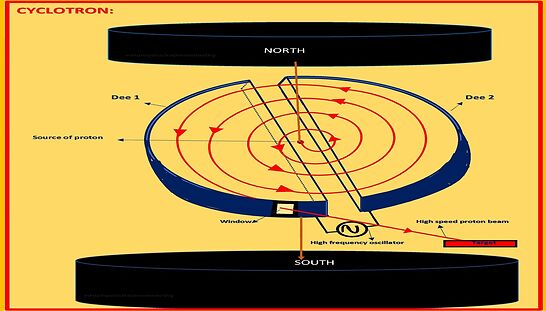
Introduction to Cyclotron and its working Principle
What is a Cyclotron?
The cyclotron was one of the earliest types of particle accelerators and is still used as the first stage of some large multi-stage particle accelerators.In a cyclotron, charged particles are propelled to high energy by a combination of electric and magnetic fields. When Ernest O. Lawrence created it in 1932, it revolutionized nuclear physics by making it possible to conduct studies on particle collisions and the creation of radioactive isotopes.
How does a cyclotron work?
Magnetic Field Influence:
Charged particles are forced along a circular trajectory by a continuous magnetic field.
Electric Field Acceleration:
Every time a particle passes across the space between two « D »-shaped electrodes (dees), an alternating electric field increases its speed.
Resonance Condition:
Constant acceleration is ensured when the electric field’s frequency coincides with the particle’s cyclotron frequency.
Cyclotrons are limited, though, in that they are unable to efficiently accelerate electrons or neutrons.
Cyclotron – Image

Why can’t a cyclotron accelerate electrons?
Electrons are so light that they get high speed soon and then their mass starts changing according to relativity theory.This starts disturbing the oscillator frequency which alternately changes the polarity of Dees and accelerates the charged particles.
In simple
Compared to heavier particles (like protons), electrons accelerate far more quickly.
According to Einstein’s relativity, their mass grows as they get closer to the speed of light.
Resonance is broken when the cyclotron’s fixed frequency can no longer keep up with the electron’s growing mass.
-
Mass of the electron is less
-
Speed will increase due to its low mass;
-
At high speed there will be a change in mass according to Einsteins theory of relativity.
-
This will alter the frequency condition
-
The frequency may not match and is said to be out of resonance condition.
Alternative Solutions:
Synchrotrons and Betatrons Synchrotrons dynamically modify frequency to correspond with relativistic particles,
whereas betatrons accelerate electrons using a fluctuating magnetic field without fixed-frequency limits.
Why can’t a cyclotron accelerate Neutrons?
Cyclotron is a device used to accelerate charged particles.Cyclotron works on the principle that a charged particle moving normal to a magnetic field experiences magnetic Lorentz force due to which the particle moves in a circular path and hence accelerates it.
Since a neutron is neutral by charge so that a cyclotron cannot accelerate it and due to the net zero charge on a neutron it cannot be so easily accelerated by any method.
Comparison: Cyclotron Vs Other particle Accelerators
|
S.No. |
Feature |
Cyclotron |
Synchrotron |
Betatron |
|
1. |
Best for |
Protons, ions |
Electrons, protons |
Electrons |
|
2, |
Neutron acceleration? |
No |
No (but can produce neutrons |
No |
|
3. |
Electron acceleration? |
No |
Yes |
Yes |
|
4. |
Relativistic adjustment? |
No |
Yes |
Yes |
Conclusion:
Cyclotron is a particle accelerator most suitably used to accelerate positively charged particles like proton, deutrons,alpha particles etc., but not the electrons and neutrons.
Although they are effective at speeding protons and heavy ions, cyclotrons are ineffective at accelerating electrons because of relativity and radiation losses, and neutrons because of neutrality. These voids are filled by alternative accelerators, such as betatrons and synchrotrons, which are crucial to contemporary particle physics.
Laisser un commentaire