
Kirchhoff’s laws, the current law (which applies the concept of charge conservation) and the voltage law (which applies the principle of energy conservation), give a systematic way to addressing complicated circuits.Kirchhoff’s current law (KCL) is crucial in contemporary measurement techniques and is commonly used in electrical engineering to establish how current is distributed in a circuit, is critical in electrical circuit design, and is critical in detecting flaws or abnormalities in electrical systems.
The Kirchhoff’s voltage law (KVL) is frequently used in mesh analysis, which is a technique for analyzing circuits with many loops.Engineers may use this rule to better understand voltage distribution, evaluate complex circuits, measure voltage, and ensure proper circuit performance.In this discussion, we will look at determining the unknown values, illustrating how they might be used in practice.
KIRCHHOFF’S LAW -NUMERICAL
Find the current in each wire using Kirchhoff’s voltage law (the second law)

KIRCHHOFF’S LAW-SOLUTION
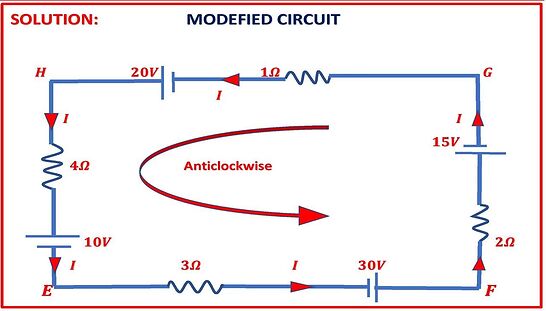
MODIFIED CIRCUIT

KIRCHHOFF’S SECOND LAW:
Kirchhoff’s second law is also known as VOLTAGE LAW (OR) LOOP LAW.This law is based on LAW OF CONSERVATION OF ENERGY.Kirchhoff’s second law states that » THE ALGEBRAIC SUM OF ALL THE POTENTIAL DIFFERENCES ALONG A CLOSED LOOP IS ZERO ».
CONVENTIONS:
-
Take any direction as the direction of traversal.(Either clockwise or anticlockise)
-
EMF of the cell is POSITIVE if the direction of the traversal is from its NEGATIVE terminal to POSITIVE terminal. (NPP)
-
EMF of the cell is NEGATIVE if the direction of the traversal is from its POSITIVE terminal to NEGATIVE terminal. (PNN)
-
The IR product is taken as POSITIVE if the resistor is traversed in the same direction as the assumed current.
KIRCHHOFF’S LAW NUMERICAL-SOLUTION
The modified circuit is shown above. All elements are connected in series.Here we can select the direction of traversal as anti-clockwise.
In a series combination of the circuit,the current through all the components is the same.
Consider the current through each element be I . Now we can apply Kirchhoff’s second law

CONCLUSION
Kirchhoff’s laws, based on the notion of charge and energy conservation, enable us to understand and predict the behavior of electrical circuits.Kirchhoff’s laws are useful tools for electrical engineers and other circuit specialists.These guidelines are used to solve complex circuit problems and to construct electrical systems.
Kirchhoff’s laws allow us to calculate current, voltage, and resistance in a circuit.Engineers and students can improve their abilities to solve complicated circuits and create efficient electrical systems by exercising these rules.Kirchhoff’s rules remain an important framework in the field of electrical engineering for technological and innovative breakthroughs.
LINKS to this topic

 Chat With Us
Laisser un commentaire