
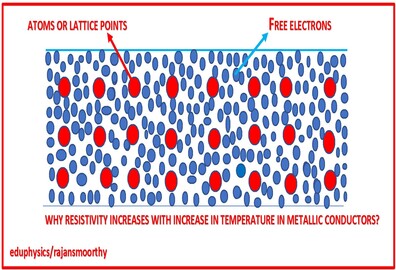
Electrical resistivity is a measurement of how vehemently a substance resists current passage through it.Based on the resistivity levels and how the materials behave in electrical circuits, substances can be categorized as conductors, semiconductors, or insulators.There are many situations in real life when the reciprocal relationship between electrical resistivity and conductivity might be used.
Silver and copper, which have low resistivity values, are frequently used in electrical wiring, whereas manganin, an alloy with high resistivity, is utilized in the heating components of electric heaters.Electric current flow through a substance is measured by its electrical conductivity.Let’s talk about resistivity and conductivity in this context.
ELECTRICAL RESISTIVITY – IMAGE

RESISTANCE OF A MATERIAL

ELECTRICAL RESISTIVITY

RESISTIVITY – S.I.UNIT

RESISTIVITY – DIMENSIONAL FORMULA

RESISTIVITY -PROPERTY

FACTORS ON WHICH RESISTIVITY DEPENDS
- Nature of the material
- Temperature
- (Not on the dimensions of wire)
LABORATORY METHODS TO FIND THE RESISTIVITY VALUE OF A GIVEN MATERIAL (USING A METER BRIDGE)

USING OHM’S LAW METHOD

RESISTIVITY VALUE OF AN ALLOY

ELECTRICAL CONDUCTIVITY
Conductivity is the inverse of resistivity.
How strongly a material resists or conducts electric current. (OR)
Ability of a conductor to conduct.
CONDUCTIVITY-SYMBOL AND OTHER NAME

CONDUCTIVITY- S.I UNIT AND DIMENSIONAL FORMULA

CALCULATING THE VALUE OF CONDUCTIVITY

RESISTIVITY APPLICATIONS IN REAL-LIFE SITUATIONS
Resistivity has several scientific and technological uses, including electrical wiring, heating elements, resistors, semiconductors, and geophysics.
Electrical wiring
To guarantee that the conductors have the proper resistance to effectively transport electrical power, resistivity is employed in the construction of electrical wires and cables. (Wired electrical system)
Due to their low resistivity values, copper and silver are the two materials that are most frequently used for wire systems. Silver and copper have respective resistivities of 1.6X10⁻⁸ ohm metres and 1.68X10⁻⁸ ohm metres. They are regarded as the greatest electrical conductor because of their low resistivity values.
Heating element
Electric stoves, toasters, ovens, and other appliances’ heating elements are often designed using resistivity.Compared to their component, Alloys have higher resistivity than their constituent metals, used for their ability to generate heat when an electric current flows through that.
Resistors
To obtain the appropriate degree of resistance in a circuit, resistors are constructed with particular resistivity values.
Semiconductors
These resistivity values are needed while developing semiconductors.Electronic devices including diodes, transistors, and integrated circuits employ semiconductors.
Geo-physics
Resistivity in geophysics aids in the discovery of geological formations including mineral deposits, subterranean water sources, and oil and gas reserves.
CONCLUSION
For pupils in secondary school, it is crucial to comprehend the fundamental physics concepts of electrical resistivity and conductivity.These ideas are crucial for applications including electrical wiring, heating elements, geophysics, resistors, and semiconductors..Students may comprehend the behaviors and relevance of these two interactions by comprehending their reciprocal relationships.
LINKS TO THIS TOPIC

 Chat With Us
Laisser un commentaire