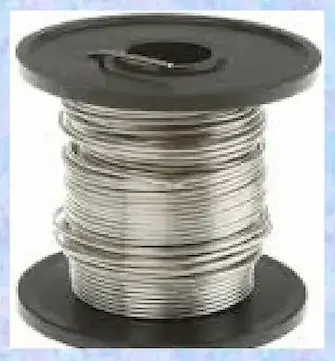
Introduction to Resistance of a wire:
Anyone working with electrical circuits, including engineers and students, needs to understand the resistance of a wire. Resistance affects performance and efficiency by determining how much a wire opposes the flow of electric current.
Resistance and its cause, the main factors influencing resistance,Ohm’s Law and wire resistance-core connection, real-world applications,and precise resistance measurement will all be covered in this tutorial.
What is resistance?
The characteristic of a material that limits electron mobility is called resistance.
An electric field is produced throughout the circuit when a potential difference is applied across a conductor, which causes the free electrons to drift or move and collide with the metal particles. A conductor’s resistance increases with the amount of impact its electrons experience.

What is the reason for resistance?
Electrons colliding with the metal particles of the conduit they pass through is the main source of resistance. Active energy is transferred, the electrons slow down, and obstruction occurs when these electrons collide.
What Determines the Resistance of a Wire?
A wire’s resistance is determined by four main factors:
Material (Resistivity)
Length
Thickness (Cross-sectional Area)
Temperature
Material (Resistivity):
A conductor’s resistance depends on the composition of the material as well as its dimensions.
Larger molecules should make more electrons available, and when the material is densely packed, the electrons will be subjected to more constant collisions, increasing the obstruction.
With a copper wire, electrons can flow freely, but with a steel wire of the same size and shape, they cannot flow efficiently.
Length:
Resistance is higher in longer wires.
The resistance of a conductor is straightforwardly corresponding to the length of the conductor. A long, slim copper wire has higher obstruction than a short,thick copper wire.
Thickness (Cross-sectional Area):
Resistance is decreased by thicker wires.
Since electrons can travel through a thick conductor without being struck or captured by an atom, it has the least amount of barrier.
Because electrons encounter higher resistance and have fewer free paths through the conductor, thin conductors have the most blockage.
Temperature:
A wire’s resistance typically rises when heated.
Temperature frequently affects the resistance of wire resistors and other components.
As the temperature rises, electrons start to vibrate, increasing the particles’ sufficient vibration. Collisions become continuous as a result of their energy expansion, and the conductor’s resistance increases.
The Role of Resistivity (Material Property)
Why do some materials have higher resistivity?
| S.No. | Material type | Resistivity
(ϼ) |
Reason for higher/lower resistivity |
| 1. | Copper
(Conductor) |
Low | Free moving electrons in their outer shell that move easily.
Metallic bonds allow electrons to drift with minimal resistance |
| 2. | Rubber
(Insulator) |
Very high | Electrons are tightly bound to atoms,preventing movement.
Large band gap between valence and conduction band. |
| 3. | Silicon
(Semiconductors) |
Moderate | Can be controlled via doping/temperature.
(Conductivity increases with temperature or doping) |
| 4. | Nichrome
(Alloy) |
High | Electron scattering due to mixed atomic structure.
(Electron movement is hindered by different atomic structure) |
Copper vs. Aluminium: Which is Better for Conductivity?
More conductive but more costly is copper (ρ ≈ 1.68×10⁻⁸ Ω·m).
Though less effective,aluminum (ρ ≈ 2.82×10⁻⁸ Ω·m) is less expensive.
Quick Formula: R = ρL/A (Resistance Calculation)

Ohm’s Law and Wire Resistance: The Core Connection
The Fundamental Link:
Reduced current due to increased resistance:
According to Ohm’s Law, a wire with high resistance,caused by its length, thinness, or high resistivity,will have a lower current for the same voltage.
Less resistance leads to more current:
More current can flow through a wire that has low resistance, such as one that is short, thick, or composed of copper or another good conductor.
Effect on the Flow of Current:
According to Ohm’s Law, a higher wire resistance lowers current for a given voltage.
Dependency on Materials:
Because of their low resistance, conductors (such as copper and aluminum) guarantee a small voltage drop.
Because of their high resistance, insulators stop current flow.
Effects of Length and Thickness:
Resistance falls with thickness R ∝ 1/A and rises with length R ∝ l
The amount that a material resists is determined by its resistivity, a material-dependent property.
Dependence on Temperature:
In metals, resistance typically rises with temperature, affecting circuit performance.
Practical Circuit Design
Ohm’s Law is used by practical circuit design engineers to select the right wire sizes and materials to ensure efficiency and security.
Transmission of Power:
Power lines use thick, low-resistance wires because high-resistance wires waste energy as heat (P = I^2R).
How Length & Thickness Affect Wire Resistance
Why Longer Wires Have Higher Resistance
Higher resistance results from more collisions caused by electrons traveling farther.For instance, thick wires are used in power transmission lines to reduce resistance over extended distances.
How Electricians Choose the Right Wire Gauge
Thicker gauges for high-current applications.
Thinner gauges for circuits with minimal power.
Does a Shorter Wire Always Mean Less Resistance?
Yes, but thickness and substance also matter.
Does Temperature Increase or Decrease Resistance?
Most metals:
Temperature causes resistance to rise.
As the temperature rises, electrons start to vibrate, increasing the particles’ sufficient vibration. Collisions become continuous as a result of their energy expansion, and the conductor’s resistance increases.
Carbon and semiconductors:
Thermal Energy:
In both carbon materials and semiconductors, increased temperature supplies energy to charge carriers, influencing their mobility and conductivity.
Practical Applications: Why Wire Resistance Matters
In practical electrical and electronic applications, wire resistance is essential. This is why it’s important:
Power Transmission Energy Loss:
Resistance in power lines results in the loss of energy as heat.
High voltage transmission is used to reduce loss by lowering current and, consequently, heat loss.
Practical Illustrations:
From Electronics to Power Lines
Lines of power: Low-resistance, thick wires to minimize energy loss.
Circuit boards: Precise resistance values on thin traces.
Heating Components (Bulbs, Toasters, and Electric Heaters):
Heat is produced by resistance in devices such as filament bulbs and heaters.
For regulated heating, materials with high resistance, such as nichrome, are employed.
Electrical Wiring Voltage Drop:
In circuits or buildings, long wires can lower voltage at the load end.
Significant voltage drops are avoided by using thicker, low-resistance wires.
Battery and Circuit Efficiency
Internal resistance in batteries affects performance.
High resistance causes lower output and heating, reducing battery life.
Short Circuits and Safety Concerns
Low-resistance paths can lead to excessive current, causing overheating and fire risks.
Fuses and circuit breakers use resistance principles to protect circuits.
Efficiency of Batteries and Circuits:
Battery performance is impacted by internal resistance.
Low output and heating brought on by high resistance shorten battery life.
How to Measure Resistance of a Wire Accurately
Measuring the Resistance of a wire using Ohm’s law
You can measure the resistance of a wire using a simple experiment:Connect the wire to a circuit with a known voltage source and an ammeter.
Measure the current flowing through the wire.
Apply Ohm’s Law: R = V/I

Measuring the Resistance of a wire using Meter Bridge
The Wheatstone bridge balancing conditions principle is used by the meter bridge. This shows the circuit connections and experimental setup. When the circuit connections are complete, the jockey is pressed near the meter bridge wire ends A and B.
There is enough known resistance in the dial/plug type resistance box. Select the known resistance R values for which the balancing length gets close to the midpoint of the meter bridge wire. The pencil jockey is carefully pushed over the meter bridge wire to find the null deflection in the galvanometer.
If the galvanometer’s deflections are on one side, there is a problem with the circuit connections. Check for double side deflections on the galvanometer.With X and R positioned differently, repeat the experiment.

DIY Experiment: Measuring Resistance with a Multimeter
Set the multimeter to Ohms (Ω) mode.
Touch probes to wire ends.
Record reading (ensure no external current flows).
Can Resistance Be Completely Eliminated?
No, resistance in regular conductors cannot be totally removed, but in superconductivity and other special circumstances, it can be significantly decreased.
Although it is very low, resistance exists in even the best conductors, such as copper and silver.
Superconductors: In certain situations, they have zero resistance
Certain materials can achieve superconductivity, a state in which resistance is precisely zero, when cooled below a critical temperature.
Calculating the Resistance of a wire- Practice Numerical Problems
| S.No. | Resistivity | Length | Area | Resistance |
| Ω-m | m | m^2 | Ω | |
| 1. | 1.7 x 10^-7 | 2 | 1.0 x 10^-6 | ? |
| 2. | 2.5 x 10^ -8 | 3 | 5.0×10^-5 | ? |
| 3. | 1.7 x 10^-8 | 4 | 2.5 x 10^-6 | ? |
| 4. | 2,65x 10^-8 | 5 | 1.0x 10^–5 | ? |
| 5. | 1.1 x 10^-6 | 1.5 | 0.75 x 10^-6 | ? |
Answer for the Practice Numerical Problems
| S. No. 1 | S. No. 2 | S. No. 3 | S. No. 4 | S. No. 5 |
| 0.34 Ω | 0.0015 Ω | 0.027 Ω | 0.013 Ω | 2.2 Ω |
Conclusion:
Understanding wire resistance helps in designing efficient circuits, reducing energy loss, and selecting the right materials. Whether you’re a student or an engineer, mastering these concepts is essential for working with electricity.
Links to this post
Resistivity of the material of a wire
Laisser un commentaire