
Introduction: Mastering Resistance and Resistivity for NEET Physics
Greetings, prospective NEET students!. Are you prepared to master resistance and resistivity, one of the most basic yet often tested concepts in NEET physics? With about 80 carefully constructed numerical problems, this blog post is your go-to « practice ground » for strengthening your comprehension and improving your problem-solving abilities.
We cover everything, from the fundamentals of calculating resistance and resistivity to exploring the intricacies of temperature dependence, the consequences of bending or stretching a wire, and the difficulties of series and parallel combinations.You’ll work through problems that include calculating cross-sectional area, comprehending the effects of cutting and recombining wires in parallel, and even figuring out the circuit configurations’ maximum to minimum resistance ratio.
Every question is meant to test you and replicate the format of the NEET exam pattern and challenge you to think critically. So grab your pen and paper, and let’s dive into this comprehensive set of practice questions to ensure you’re fully prepared to ace the NEET physics section.
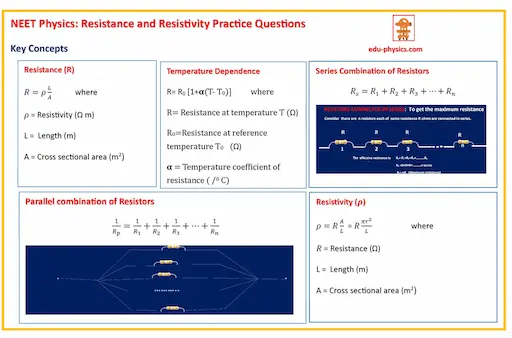
Neet Physics: Resistance and Resistivity-Key Concepts

Problem 1: Calculating Resistance of a wire
| S.No. | Resistivity (⍴) | Length (L) | Area (A) | Resistance(R) |
| Unit
→ |
Ω-m | m | m^2 | Ω |
| 1. | 1.7 x 10^-7 | 2 | 1.0 x 10^-6 | ? |
| 2. | 2.5 x 10^ -8 | 3 | 5.0×10^-5 | ? |
| 3. | 1.7 x 10^-8 | 4 | 2.5 x 10^-6 | ? |
| 4. | 2.65x 10^-8 | 5 | 1.0x 10^–5 | ? |
| 5. | 1.1 x 10^-6 | 1.5 | 0.75 x 10^-6 | ? |
Problem 2 :Calculating Resistivity of a wire

| S.No | Question | Answer |
| 1. | Calculate the resistivity of a material of a wire of 10 m long, 0.4 mm in diameter and having a resistance of 20 Ω | ? |
| 2. | Find the resistivity of a conductor in which a current density of 2.5 Am^-2 is found to exist when an electric field of 15 V/m is applied on it | ? |
| 3. | A negligible small current is passed through a wire of length15 m and uniform cross-section 6.0x 10^-7 m2, and its resistance is measured to be 5.0 Ω.What is the resistivity of the material at the temperature of the experiment | ? |
| 4. | Calculate the resistivity of a material of a wire of 5 m long, 0.45 mm in diameter and having a resistance of 15 Ω | ? |
| 5. | Find the resistivity of a conductor in which a current density of 4.0 Am^-2 is found to exist when an electric field of 15 V/m is applied on it | ? |
Problem 3: Finding Cross Sectional Area

| S.No | Question | Answer |
| 1. | A wire of length 2 m has a resistance of 10 Ω . If the resistivity of the material is 5x 10^-7 Ωm. Calculate the area of the cross section of the wire. | ? |
| 2. | The resistance of a wire is 20 Ω. If its area of cross section is increased by 25% by drawing it out.What will be the new resistance of the wire? | ? |
| 3. | A 10 m long wire with a diameter of 0.4 mm has a resistance of 5 Ω.Calculate the electrical conductivity of the material of the wire.From this , determine the area of the cross section of the wire. | ? |
| 4. | A wire of length 6 m has a resistance of 10 Ω . If the resistivity of the material is 4.5x 10^-7 Ωm. Calculate the area of the cross section of the wire. | ? |
Problem 4: Temperature Dependence of Resistance

| S.No. | Question | Answer |
| 1. | A resistor has a resistance of 10 Ω at 20 degree Celsius. If the temperature coefficient of resistance is 0.004 per degree Celsius.Find its resistance at 100 degree Celsius. | ? |
| 2. | A copper wire has a resistance of 50 Ω at 20 degree Celsius. If the temperature coefficient of resistance is 0.004 per degree Celsius .Find its resistance at 80 degree Celsius. | ? |
| 3. | A wire has a resistance of 10 Ω at 0 degree Celsius and 12 Ω at 50 degree Celsius.Calculate its temperature coefficient α. | ? |
| 4. | A carbon resistor has R0 =100 Ω at 20 degree Celsius with α= – 0.0005 per degree Celsius.Find its resistance at 60 degree Celsius. | ? |
| 5. | A tungsten wire has R0 =200 Ω at 25 degree Celsius and R=240 Ω at some temperature T If α= 0.0045 per degree Celsius,find T | ? |
| 6. | An aluminium wire (α= 0.0039 per degree Celsius) and a silver wire (α= 0.0038 per degree Celsius) each have R0 =50 Ω at 30 degree Celsius.Which has higher resistance at 80 degree Celsius ? | ? |
| 7. | A wire has a resistance of 5 Ω at 20 degree Celsius. If its temperature coefficient α= 0.004 pedigree Celsius.Find its resistance at 100 degree Celsius. | ? |
| 8. | A silver wire has a resistance of 2.1 Ω at 27.5 degree Celsius, and a resistance of 2.7 Ω at 100 degree Celsius.Determine the temperature coefficient of resistivity of silver | ? |
Problem 5: Effect of stretching a wire on resistance

| S.No, | Questions | Answer |
| 1. | A wire of resistance 10 Ω is stretched to twice its original length without changing its volume.Calculate its new resistance. | ? |
| 2. | A wire of resistance 8 Ω is stretched such that its length increases by 50%.Find its new resistance. | ? |
| 3. | A wire of resistance 12 Ω is stretched until its diameter reduces to half.Find its new resistance. | ? |
| 4. | A wire of resistance 5 Ω is stretched without changing its diameter, but its length doubles.Find its new resistance. | ? |
| 5. | A wire of resistance 20 Ω is stretched such that its cross sectional area reduces to one-third.Find its new resistance. | ? |
| 6. | A wire of resistance 6 Ω is stretched to three times its original length without changing its volume.Find its new resistance. | ? |
| 7. | A wire of resistance 16 Ω is stretched such that its length increases by 25%.Find its new resistance. | ? |
| 8. | A wire of resistance 9 Ω is stretched until its radius reduces to one-third of its original value.Find its new resistance. | ? |
| 9. | A wire of resistance 4 Ω is stretched such that its cross-sectional area becomes one-fourth of its original value, Find its new resistance. | ? |
| 10. | A wire of resistance 10 Ω is stretched such that its length triples and its diameter is halved.Find its new resistance. | ? |
| 11. | A wire of 10 Ω resistance is stretched to thrice its original length. What will be its (i) new resistivity, and (ii) new resistance | ? |
Problem 6: Resistance of a Bent Wire
| S.No | Questions | Answer |
| 1. | A wire of resistance 5 Ω is bent into a circle.What is the effective resistance between two diametrically opposite points? | ? |
| 2. | A wire of resistance 12 Ω is bent into a circle.What is the effective resistance between two diametrically opposite points of the circle? | ? |
| 3. | A uniform wire of length 2 m and resistance 8 Ω is bent into a square.Find the resistance between two adjacent corners of the square. | ? |
| 4. | A wire of resistance 24 Ω is bent into an equilateral triangle.Find the resistance between any two vertices. | ? |
| 5. | A uniform wire of resistance 40 Ω is bent into a square. Find the resistance between two diagonally opposite corners. | ? |
| 6. | A wire of length L and resistance R is bent into a circle.What is the resistance between two points that subtends at an angle of 900 at the centre. | ? |
| 7. | A wire of resistance 36 Ω is bent to form a regular hexagon.Find the resistance between two adjacent vertices. | ? |
| 8. | A wire of resistance 60 Ω is bent into a square.Calculate the resistance between midpoints of two adjacent sides. | ? |
| 9. | A uniform wire of length l and resistance R is bent into a semicircle.Find the resistance between the ends of the semicircle. | ? |
| 10. | A wire of resistance 18 ohms is bent into an equilateral triangle.Find the resistance between any two vertices | ? |
Problem 7: Series Combination of Resistors

| S.No | Question | Answer |
| 1. | Three resistors of 2 Ω ,4 Ω and 6 Ω are connected in series to
A 24 V battery.Find the total resistance and current through each resistor. |
? |
| 2. | Three resistors 1 Ω ,2 Ω and 3 Ω are connected in series to a 12 V battery.Find the power dissipated by the 2 Ω resistor | ? |
| 3. | A 6 Ω resistor and a 3 Ω resistor are connected in series to a 9 V battery.What is the total current drawn from the battery? | ? |
| 4. | When resistors are connected in series, what happens to the current flowing through each resistor? | ? |
| 5. | Four resistors of 2 Ω ,4 Ω, 6 Ω and 8 Ω are connected in series to
a 12 V battery.Find the total resistance and current through each resistor. |
? |
Problem 8: Changing Length and Area of a Wire
| S.No | Question | Answer |
| 1. | A nichrome wire has a resistance of 6 Ω.If its length is increased by 50% and cross-sectional area is reduced by 25%, find the new resistance | ? |
| 2. | A wire has a resistance of 10 Ω.If its length is doubled while keeping the cross sectional area same.What will be the new resistance | ? |
| 3. | A wire with a resistance of 5 Ω is stretched such that its length becomes 3 times its original length( assuming volume remains constant).Find the new resistance. | ? |
| 4. | A wire has a resistance of 8 Ω.If its cross sectional area is halved keeping the length constant.What is the new resistance? | ? |
| 5. | A wire with a resistance of 12 Ω is stretched to twice its original length (volume remains the same). Find its new resistance | ? |
| 6 | A wire has a resistance of 6 Ω.If its length is tripled and its cross sectional area is doubled.What will be the new resistance | ? |
Problem 9: Parallel Combination of Resistors

| S.No | Question | Answer |
| 1. | Three resistors 2 Ω, 4 Ω,and 5Ω are combined in parallel.What is the total resistance of the combination | ? |
| 2. | How can three resistors of resistance 2 Ω, 3 Ω and 6 Ω be connected to give a total resistance of 1 Ω ? | ? |
| 3. | Show how you would connect three resistors, each of resistance 6 Ω,so that the combination has a resistance of 9 Ω | ? |
| 4. | Three resistors 2 Ω, 4 Ω,and 5Ω are combined in parallel I the total current through the combination is 6A. What is the current flowing through the 2 Ω resistor? | ? |
| 5. | A parallel combination of two resistors R1 and R2, has a total resistance of 2 Ω .If R1 = 6 Ω . What is the value of R2 | ? |
| 6 | Two resistors are connected in parallel.The equivalent resistance of the combination is 6/5 Ω. If one resistor has a value of 2 Ω.What is the value of other resistance? | ? |
Problem 10: Cutting and Parallel combination

| S.No. | Question | Answer |
| 1. | A wire of resistance 12 Ω is cut into three equal parts. If these parts are connected in parallel, what is the equivalent resistance? | ? |
| 2. | A 20 Ω resistor is connected in parallel with a variable resistor R. If the total resistance becomes 4 Ω., find R. | ? |
| 3. | A wire of resistance R is cut into n equal parts.These parts are connected in parallel.Derive the equivalent resistance | ? |
| 4. | A wire of resistance 80 Ω is cut into 5 equal parts.These parts are connected in parallel.Derive the equivalent resistance | ? |
| 5. | A uniform wire of length l and resistance R is cut into n equal parts and connected in parallel .In what factor does the resistance decrease | ? |
Problem 11: Ratio of maximum to minimum resistance when n identical resistors are connected


| S. No | Question | Answers |
| 1. | What is the ratio of maximum to minimum resistance in a circuit made up of two identical resistors of 10 ohms each? | ? |
| 2. | What is the ratio of maximum to minimum resistance in a circuit made up of three identical resistors of 10 ohms each? | ? |
| 3. | What is the ratio of maximum to minimum resistance in a circuit made up of four identical resistors of 10 ohms each? | ? |
| 4. | What is the ratio of maximum to minimum resistance in a circuit made up of five identical resistors of 10 ohms each? | ? |
| 5. | What is the ratio of maximum to minimum resistance in a circuit made up of ten identical resistors of 10 ohms each? | ? |
| 6. | What is the ratio of maximum to minimum resistance in a circuit made up of twenty identical resistors of 10 ohms each? | ? |
Answers for the Numerical problems
Problem 1: Calculating resistance- Answers
| S. No. 1 | S. No. 2 | S. No. 3 | S. No. 4 | S. No. 5 |
| 0.34 Ω | 0.0015 Ω | 0.0272 Ω | 0.013 Ω | 2.2 Ω |
Problem 2: Calculating Resistivity of a wire- Answers
| S.No:1 | S.No:2 | S.No:3 | S.No:4 | S.No:5 |
| 2.513×10^–7 Ω.m | 6 Ω.m | 2.0 x 10^-7 Ω.m | 4.77×10^–7 Ω.m | 3.75 Ω.m |
Problem 3: Finding Cross Sectional Area-Answers
| 1 | 2 | 3 | 4 |
| 1×10^-7 m^2 | 12.8 Ω | 1,256×10^-7 m^2 | 2.7x 10^-7 m^2 |
Problem 4 :Temperature Dependence of Resistance-Answers
| 1 | 2 | 3 | 4 | 5 |
| 13.2 Ω | 62 Ω | 0.004 per
degree Celsius |
98 Ω | 69.440 C |
| 6 | 7 | 8 |
| Al(59.75 Ω)
Ag(59.5 Ω) Ans:Al |
6.6 Ω | 0.00394 per
degree Celsius |
Problem 5: Effect of stretching a wire on resistance-Answers
| S.No. | Question | Given physical quantities | Formula used | Key steps | Answer |
| 1, | A wire of resistance 10 Ω is stretched to twice its original length without changing its volume.Calculate its new resistance. | R1=10 Ω
L2 =2L1 R2 =? Volume constant |
R=ρL/A
A1L1=A2L2 |
A2= A1/2 | 40 Ω |
| 2. | A wire of resistance 8 Ω is stretched such that its length increases by 50%.Find its new resistance. | R1=8 Ω
L2 =1.5 L1 R2 =? Volume constant |
R=ρL/A
A1L1=A2L2 |
A2= A1/1.5 | 18 Ω |
| 3. | A wire of resistance 12 Ω is stretched until its diameter reduces to half.Find its new resistance. | R1=12 Ω
L2 =1.5 L1 d2 =d1/2 R2 =? Volume constant |
A∝d2R=ρL/A
A1L1=A2L2 |
A2= A1/1.5
L2=4L1 |
192 Ω |
| 4. | A wire of resistance 5 Ω is stretched without changing its diameter, but its length doubles.Find its new resistance. | R1=5 Ω
L2 =2 L1 R2 =? Volume constant |
R2=2R1 | 10 Ω | |
| 5. | A wire of resistance 20 Ω is stretched such that its cross sectional area reduces to one-third.Find its new resistance. | R1=20 Ω
A2=A1/3 Volume constant |
R2=9R1 | L2=3L1
R2=9×20 |
180 Ω |
| 6. | A wire of resistance 6 Ω is stretched to three times its original length without changing its volume.Find its new resistance. | R1=6 Ω
L2 =3 L1 R2 =? Volume constant |
R2=9R1 | 54 Ω | |
| 7. | A wire of resistance 16 Ω is stretched such that its length increases by 25%.Find its new resistance. | R1=16 Ω
L2 =1.25L1 R2 =? Volume constant |
R2=1.562R1 | 25 Ω | |
| 8. | A wire of resistance 9 Ω is stretched until its radius reduces to one-third of its original value.Find its new resistance. | R1=9 Ω
r2 =r1/3 R2 =? Volume constant |
L2 =9L1 | R2=81R1 | 729 Ω |
| 9. | A wire of resistance 4 Ω is stretched such that its cross-sectional area becomes one-fourth of its original value, Find its new resistance. | R1=4 Ω
A2=A1/4 Volume constant |
R2=16R1 | 64 Ω | |
| 10. | A wire of resistance 10 Ω is stretched such that its length triples and its diameter is halved.Find its new resistance. | R1=10 Ω
L2 =3 L1 d2 =d1/2 R2 =? Volume constant |
R2=12R1 | 120 Ω | |
| 11. | A wire of 10 Ω resistance is stretched to thrice its original length. What will be its (i) new resistivity, and (ii) new resistance | R=ρL/A | Resistivity remains unchanged
(ii)R=90 Ohms |
Problem 6: Resistance of a Bent Wire-Answers
| S.No:1 | S.No:2 | S.No:3 | S.No:4 | S.No:5 |
| 1.25 Ω | 3 Ω | 1.5 Ω | 5.33 | 10 |
| S.No:6 | S.No:7 | S.No:8 | S.No:9 | S.No:10 |
| 3R/16 Ω | 5 Ω | 6.25 Ω | R/4 Ω | 4 Ω |
Problem 7: Series Combination of Resistors-Answers
| 1 | 2 | 3 | 4 | 5 |
| 12 Ω
2 A |
6 Ω
8 W |
1 A | Remains
the same |
20 Ω
0.6 A |
Problem 8: Changing Length and Area of a Wire-Answers
| 1 | 2 | 3 | 4 | 5 | 6 |
| 12 Ω | 20 Ω | 45 Ω | 16 Ω | 48 Ω | 9 Ω |
Problem 9: Parallel Combination of Resistors- Answers
| 1 | 2 | 3 | 4 | 5 | 6 |
| 1.05 Ω | Parallel | 2 parallel & the
combination in series |
3.16 A | 3 Ω | 3 Ω |
Problem 10: Cutting and Parallel combination-Answers
| 1. | 2 | 3 | 4 | 5 |
| 1.33 Ω | 5 Ω | R/n^2 | 3.2 Ω | n^2 |
Problem 11: Ratio of maximum to minimum resistance when n identical resistors are connected
| S. No | Number of resistors | Resistance of each resistor (R) | Maximum resistance
(Series) |
Minimum resistance
(parallel) |
RmaxRmin | Ratio of maximum to minimum |
| 1 | 2 | 10 Ω | 20 | 102= 5 Ω | 205 | 4:1 |
| 2 | 3 | 10 Ω | 30 | 103 = 3.33 Ω | 303.33 | 9:1 |
| 3 | 4 | 10 Ω | 40 | 104 = 2.5 Ω | 402.5 | 16:1 |
| 4 | 5 | 10 Ω | 50 | 105 = 2 Ω | 502 | 25:1 |
| 5 | 10 | 10 Ω | 100 | 1010 =1 Ω | 1001 | 100:1 |
| 6 | 20 | 10 Ω | 200 | 1020 = 0.5 Ω
|
2000.5 | 400:1 |
Conclusion:Your path to NEET Physics Success
Well done for completing this comprehensive set of practice questions on resistivity and resistance! You have strengthened your theoretical knowledge and improved your problem-solving skills in a variety of situations by carefully working through these 70+ numericals.Keep in mind that mastering NEET physics requires constant practice.
From simple calculations to more intricate circuit analysis and the consequences of physical changes on resistance, the wide variety of questions has helped you get ready for a variety of variations you may face on the real test.Continue going over these ideas, practise frequently, and do not be afraid to go over any areas where you feel less sure.With commitment and the strong foundation you have established here, you will have no trouble getting a great NEET physics score.
Links to this topic:
Resistance of a wire : Factors,Formula, and Practical Applications

 Chat With Us
Laisser un commentaire