
Focal length of a convex lens & Concave Mirror:
a). Focal length of a convex lens:
Objective:
To determine the focal length of a convex lens using a distant object (like a sun, tree or tall faraway building).
Principle:
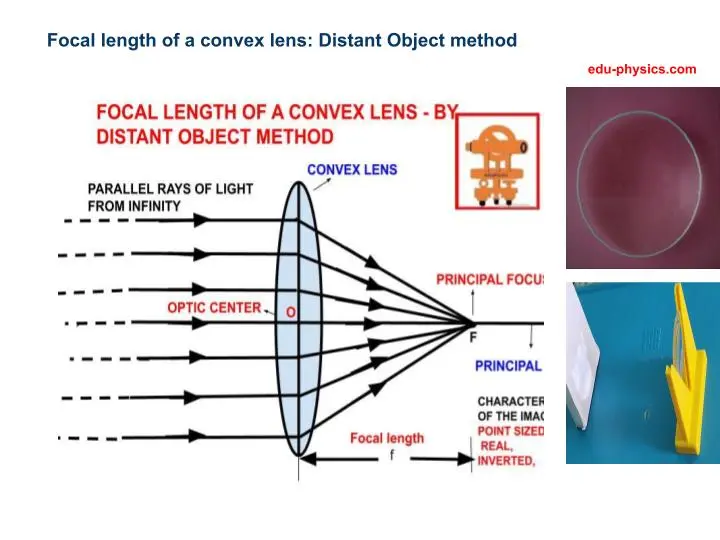
A convex lens converges parallel rays of light (from a distant object) to a point called principal focus (F). The distance between the optic centre (O) of the lens and the principal focus (F) is the focal length(f).
Focal length of a Convex lens: Distant Object method

Apparatus Required:
- Convex lens (say focal length 10, 15, 20 cm)
- Lens holder
- White screen
- Measuring scale (Least count 1 mm)
Focal Length of the convex lens (Distant Object method) – Image

Procedure:
Hold the given convex lens in a lens holder and place it facing a distant object like a tree or a faraway building.
Place the white screen on the other side of the lens.
Adjust the position of the white screen until a clear, sharp inverted image of the object is formed.
Measure the distance between the optic centre of the lens (O) and the screen where the image is clearly formed(F). This distance is approximately equal to the focal length (f) of the given convex lens.
Focal length of convex lens: Observations:

Calculations:
The image distance v is approximately equal to the focal length of the given convex lens because the object is at infinity. (u=∞)
From the lens formula 1/f=1v-1/u
Since the object distance is at infinity (u=∞) then 1/u=0
1/f=1/v f=v
And the focal length(f) is equal to the image distance(v) of the lens.
Result:
The measured distance(v) gives the focal length of the given convex lens.
The focal length of the given convex lens by distant object method = 10 cm
b) Focal length of a concave mirror
Objective:
To determine the focal length of a concave mirror using a distant object (like a sun, tree or tall faraway building).
Principle:
A concave mirror converges parallel rays of light (from a distant object) to its focus (F). The distance between the pole of the mirror (P) and the principal focus (F) gives the focal length (f).
Apparatus Required:
- Concave mirror (say focal length 10, 15, 20 cm etc.,)
- Mirror holder
- Hite screen
- Measuring scale (Least count 1 mm)
Procedure:
Place the concave mirror in a holder facing a distant object like a tree or building.
Place a white screen in front of the given convex mirror (Image is obtained after the reflection by the mirror)
Adjust the position of the screen until a clear, sharp, inverted image is formed after reflection by the mirror.
Measure the distance between the mirror and the screen. The distance is approximately equal to the focal length of the given concave mirror.
Observations:
The image distance (v) is approximately equal to the focal length (f) of the given concave mirror
From the mirror formula 1/f=1/v+1/u
Since the object distance (u) is at infinity (u=∞), 1/u=0
1/f=1/v and f=v

Calculations:
Mean focal length f (average) =10.04 cm
Accepted focal length f (accepted)= 10 cm
Percentage error =0.04/10 x 100 = 0.4%
Result:
The measured distance v gives the focal length of the given concave mirror.
The focal length of the given concave mirror was found to be = -10.04 cm
Precautions:
Use a distant object like (sun or a building far away) to ensure parallel rays.
The lens/mirror and screen should be held perpendicular to the incident light.
Perform the experiment in a bright light for a clear image
Repeat the experiment multiple times for accuracy
Link to this Experiment

 Chat With Us
Laisser un commentaire