
Refraction of light through a glass prism
Objective:
To trace the path of light rays as they pass through a glass prism and observe the phenomenon of dispersion (splitting of white light into its constituent colours).
Materials Required:
Triangular glass prism
Drawing board
White sheet of papers
Board pins
Pencil and ruler
Push pins
Protractor
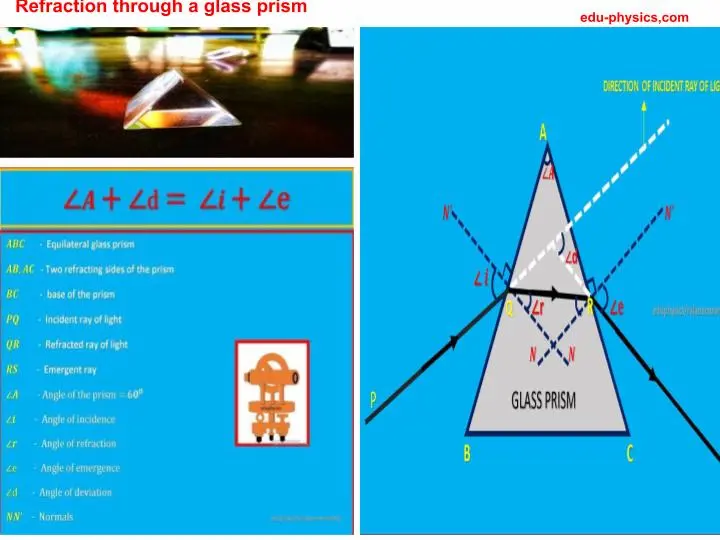
Refraction through a glass prism- Image

Procedure:
Place the provided glass prism out on a piece of white paper.
Using a pencil, sketch the prism’s outline and label it as ABC.
A narrow white light beam should be directed at an angle toward one of the prisms faces AB.
Make sure the light enters the prism obliquely, rather than perpendicularly.
When light enters the prism, it bends (refracts) because the medium changes from air to glass.
The light is divided into its component colours inside the prism (VIBGYOR: Violet, Indigo, Blue, Green, Yellow, Orange, Red).
As the light leaves the prism (from glass to air), it bends once more.
On the paper, note the incident ray (PQ), the emergent ray (RS), and the refracted ray (QR) inside the prism.
Take out the prism and sketch the path of light using a ruler.
Measure the angle of incidence (∠i), angle of refraction (∠r) and the angle of emergence (∠e)
Also observe the angle of deviation (∠d) (the angle between the incident ray and the emergent ray)
Verify that ∠A + ∠d = ∠i +∠e
Observations:
A spectrum of colours is formed when the white light splits.

Red light deviates the least and the violet most.
The emergent ray bends away from the prism’s base.
∠A + ∠d = ∠i +∠e (Verification)
Conclusion:
This experiment illustrates the phenomenon of dispersion and provides insight into how rainbows form in nature.
A glass prism breaks down white light into its component colours because different wavelengths bend at different angles (refraction).
Precautions:
For clarity, use a narrow beam of light.
Make sure the prism is positioned correctly and is clean.
This experiment is essential to the study of optics because it clarifies ideas like dispersion, refraction, and spectrum formation.
Links to this experiment:
Experiment: Tracing the path of a Light Ray Through a Rectangular Glass Slab

 Chat With Us
Laisser un commentaire