
RATIO OF MAXIMUM TO MINIMUM RESISTANCE
INTRODUCTION
The idea of series and parallel combinations of resistors, as well as their ratios, are utilised in physics and are crucial to understanding a number of phenomena, including electromagnetic induction, electrical power, and Ohm’s law. In computer science, the design of digital circuits and microprocessors makes use of this idea.
Let’s talk about the characteristics of series and parallel combinations, a straightforward mathematical formula for calculating the ratios of series and parallel resistor combinations, and the ideas behind these concepts, which are used in a variety of fields, including engineering, science, technology, electronics, computer science, battery design, ballistics, and telecommunications, among others.
CHARACTERISTICS OF A PARALLEL & SERIES CIRCUIT-IMAGE

CHARACTERISTICS OF A PARALLEL & SERIES CIRCUIT
| SERIES CIRCUIT | PARALLEL CIRCUIT |
|---|---|
| Series circuit | Parallel circuit |
| Current passing through each resistor is the same. Net effective resistance in the case of series combination is the sum of the individual resistances. Rs = R1+ R2+R3 The applied voltage is the sum of the potential difference formed across each resistor. The net effective resistance is higher than the highest resistance in the circuit. |
Current passing through each resistor is not the same. The reciprocal of the net effective resistance in the case of parallel combination is equal to the sum of the reciprocal of their individual resistances. The potential drop across each resistor is the same. The net effective resistance is lesser than the least resistance in the circuit. |
RATIO OF MAXIMUM TO MINIMUM RESISTANCE – NUMERICAL
QUESTION – 1
What is the ratio of maximum to minimum resistance in a circuit made up of two identical resistors?
SOLUTION

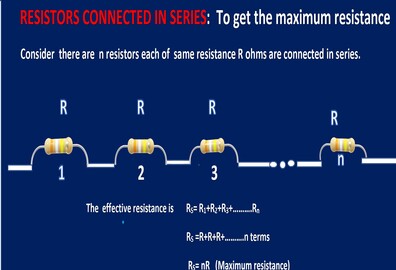
RESISTORS CONNECTED IN SERIES TO GET MAXIMUM RESISTANCE

Question – 2
What is the ratio of maximum to minimum resistance in a circuit made up of ‘n’ identical resistors?
SOLUTION
SERIES COMBINATION OF RESISTORS

RESISTORS CONNECTED IN PARALLEL- MINIMUM RESISTANCE
RATIO OF MAXIMUM TO MINIMUM RESISTANCE

QUESTION-3
A piece of wire having a resistance of R which is cut into five equal parts.These parts are then connected in parallel. If the net equivalent resistance of this combination is R’. Find the ratio of R/R’
SOLUTION

Ratio of maximum to minimum resistance- Examples
|
S. No |
Number of resistors |
Resistance of each resistor (R) |
Maximum resistance(Series) (in Ohms) |
Minimum resistance (parallel) |
Rmax/Rmin |
Ratio of maximum to minimum resistance |
|
1 |
2 |
10 Ω |
20 |
10/2= 5 Ω |
20/5 |
4:1 |
|
2 |
3 |
10 Ω |
30 |
10/3 = 3.33 Ω |
30/3.33 |
9:1 |
|
3 |
4 |
10 Ω |
40 |
10/4 = 2.5 Ω |
40/2.5 |
16:1 |
|
4 |
5 |
10 Ω |
50 |
10/5 = 2 Ω |
50/2 |
25:1 |
|
5 |
10 |
10 Ω |
100 |
10/10 =1 Ω |
100/1 |
100:1 |
|
6 |
20 |
10 Ω |
200 |
10/20 = 0.5 Ω
|
200/0.5 |
400:1 |
Key Observations:
The maximum resistance increases linearly with the number of resistors Rmax=nR
The minimum resistance decreases inversely with the number of resistors Rmin=R/n
The ratio of maximum to minimum resistance is always n square,regardless of the value of R
Practical applications of ratio of maximum to minimum resistance
- Solar panels where the resistance ratio adjusts automatically based on sunlight intensity.
- Monitoring the resistance ratio of motor windings (series vs. parallel)in industrial machinery can help predict failures or wear and tear.
- In biological systems, such as neural networks or cell membranes, where ion channels act as variable resistors.
- Use AI to design circuits with adaptive resistance ratios for renewable energy systems.
- Analyze the ratio of maximum to minimum resistance in fractal-based resistor networks, where the geometry of the network influences the overall resistance.
- The resistance ratio concept to model and optimize communication and power distribution in swarm robotics systems.
- Apply the concept of resistance ratios to acoustic systems, where impedance matching is crucial for efficient energy transfer.
- Explore the ratio of maximum to minimum resistance in nanoscale circuits, where quantum effects dominate.
- Design wearable devices that use variable resistance networks to adapt to user movement or environmental changes.
- The ratio of maximum to minimum resistance can be used for data storage.
- The ratio of maximum to minimum resistance can be used to study chaos in electrical circuits.
- The ratio of maximum to minimum resistance in neural circuits can influence signal propagation and decision-making.
CONCLUSION
For the purpose of building and assessing electrical circuits, it is essential to understand the concepts of series, parallel, and resistor combinations, as well as their ratio.A straightforward mathematical method may be used to determine the ratio of maximum to minimum resistance for identical resistors.Fundamental to the study of electrical engineering, this idea has significant real-world implications for building and improving electronic circuits.
Additionally, it plays a crucial role in the design and optimization of battery systems, particularly for those used in high voltage and high capacity applications like portable electronics, renewable energy systems, and electric vehicles.This idea is applied to the design of telephone and satellite systems as well as other communication networks in telecommunication.
It is employed in the creation and evaluation of many different types of sensors, including temperature and precision sensors.Typically, this idea is used in various fields like physics, electronics, computer science,telecommunications and sensing technologies.
Laisser un commentaire