
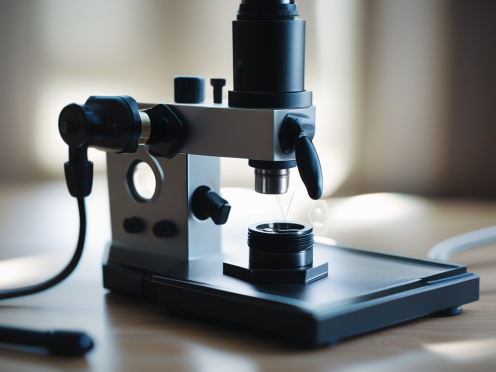

NUMERICAL ON COMPOUND MICROSCOPE
INTRODUCTION
Compound microscopy is an important tool in many sectors, including science, research, medical diagnostics, medicine, engineering, and education. A compound microscope is built using a mix of lenses and other optical components.Let us go through the concept, lens combination, operating, and magnifying power of the lenses.
The compound microscope consists of a long cylindrical tube in which one end of the tube has an objective lens (small aperture and small focal length) and the other end has an eyepiece lens (the aperture and the focal length are somewhat larger than the objective lens).
Objective lens which focuses a real image of the object,the image is further magnified by the eyepiece which gives the viewer an image that is virtual, magnified and inverted concerning the object(AB).
COMPOUND MICROSCOPE- IMAGE FORMATION

COMPOUND MICROSCOPE-IMAGE

COMPOUND MICROSCOPE:NUMERICAL-1
The objective lens and the eyepiece used in a compound microscope are of focal lengths 4 cm and 10 cm respectively. An object is placed at a distance of 6 cm from the objective lens. What will be the magnifying power and length of the compound microscope?
SOLUTION


COMPOUND MICROSCOPE:NUMERICAL-2
The objective lens and the eyepiece used in a compound microscope are of focal lengths 2 cm and 3 cm respectively.The distance between objective lens and the eyepiece lens is 15 cm. The final image is formed at infinity.What is the distance of the object and image produced by the objective from the objective lens?
SOLUTION


Compound Microscope -Practice Numerical problems with Answers
|
S.No |
Problem |
Answer |
|
1 |
A compound microscope has an objective lens of focal length 1.25 cm and an eyepiece of focal length 5 cm. The object is placed 1.3 cm from the objective. If the final image is formed 25 cm from the eyepiece, calculate: (a) Distance between the lenses (b) Magnifying power |
a) 32.26cm b)148.92 |
|
2. |
A compound microscope has an objective of focal length 1 cm and an eyepiece of focal length 2.5 cm. The object is placed 1.1 cm from the objective. If the final image is at infinity, calculate: (a) Distance between lenses (b) Magnifying power |
a) 13.5cm b)100 |
|
3. |
A microscope uses light of wavelength 500 nm. If the numerical aperture of the objective is 0.8, calculate the resolving power of the microscope. |
RP=3.2×10⁶ m-1 |
|
4. |
A microscope has an objective of focal length 1.5 cm and an eyepiece of focal length 3 cm. The tube length is adjusted so that the final image is at 25 cm. If the object is placed 1.6 cm from the objective, find the new tube length. |
L=26.68cm |
|
5. |
A compound microscope has an objective of focal length 1.2 cm and an eyepiece of focal length 4 cm. If the object is placed 1.25 cm from the objective and the final image is at infinity, calculate the angular magnification. |
M=150 |
|
6. |
A microscope has an objective of focal length 2 cm and an eyepiece of focal length 5 cm. If the object is placed 2.1 cm from the objective and the final image is at 25 cm, find the magnifying power. |
M ≈ 95.24 |
|
7. |
A compound microscope has a tube length of 20 cm, an objective of focal length 1 cm, and an eyepiece of focal length 5 cm. Find the magnifying power if the final image is at infinity. |
M = 100 |
|
8. |
A microscope uses light of wavelength 600 nm. If the numerical aperture is 0.5, calculate the smallest distance it can resolve. |
d ≈ 0.73 µm |
|
9. |
A compound microscope has an objective of magnification 20x and an eyepiece of magnification 10x. Calculate the total magnification |
M = 200 |
|
10. |
A microscope has an objective of focal length 1.5 cm and an eyepiece of focal length 3 cm. If the tube length is 18 cm, find the object distance for the objective. |
uo= -1.67 cm |
CONCLUSION
Scientists and researchers have discovered discoveries, solved problems, and improved numerous fields of knowledge using the compound microscope.It has contributed significantly to our understanding of the natural world.
The compound microscope will most likely evolve and grow more complex as technology advances. Have you ever looked at enlarged pictures of cells and tissues using a compound microscope?

 Chat With Us
Laisser un commentaire