SURFACE TENSION
Surface Tension – Definition
Surface tension is the property of a liquid surface in which the surface behaves like a thin elastic film which is attempting to minimize the area and is made by the cohesiveness of the like molecules at the surface.
Surface Tension – Causes
Minimizing the surface area:
Every framework in the universe tends to limit its potential energy. In like manner, a liquid additionally tends to minimize its surface area accordingly reduce the number of molecules residing on the free surface of the liquid.
Vander Waals forces:
A strong electrostatic force considered the ‘Vander Waals forces’ acting between neighboring water molecules making them to stick to one another.
State of energy:
A molecule in touch with a neighbor is in a lower state of energy than if it were separated from everyone else.
Sharing the charge:
The molecules present on the outer layer of the liquid have strong surface tension since they are sharing the charge among fewer molecules (boundary molecules are absent). Accordingly, they have higher energy.
Minimal Surface area:
The limited number of boundary molecules brings about a minimal surface area that leads to the surface tension.
Cohesive force:
The cohesive force inside molecule (inside) is zero since inside molecules have many neighbours and comparable cohesive force acting everywhere, which is in the lower state of energy. (See the picture).
Surface Tension- Image

Surface Tension – S.I and C.G.S unit

Surface Tension – Dimensional formula

Surface Tension- Examples
An insect can be ‘able to walk’ on water surface due to the surface tension of water.
The ‘capillary action of water'( water filling up a thin glass tube) is due to the surface tension.
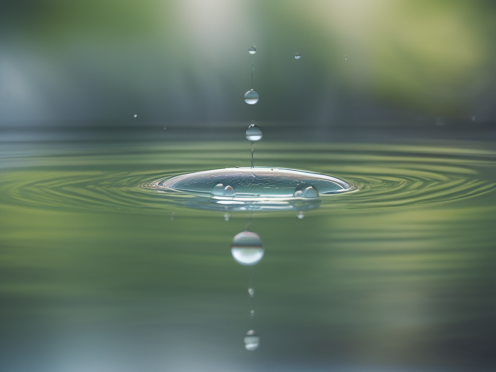
The spherical shape of the water droplets is due to the surface tensionThe membrane effect of surface tension is responsible for the uniform pressure across the entire surface of a spherical water droplet. Because molecules in the centre of a drop are drawn in all directions, no one direction is preferred.
Surface-adhered molecules are pulled inward as well as across the surface. Molecules are drawn to one another across the surface, both internally and externally. Water droplets are drawn into a spherical shape by surface tension.
Drips adhere to droppers due to surface tension’s gravitational attraction. The surface tension causes paint to form very small droplets, resulting in the uniformity of a painting surface that is free of drips and runs.
Surface Tension – Frequently Asked Questions
- Why the meniscus is concave and the wetting is high at a vertical wall in the case of water in the glass container?
- Why the meniscus is convex and the wetting is low at a vertical wall in the case of mercury in the glass container?
Laisser un commentaire