Introduction to Resistivity
Understanding resistivity, a fundamental property of materials that quantifies how strongly they oppose the flow of electric current, is essential for designing electrical circuits, choosing materials for wiring, and optimizing electronic devices.
Electric current encounters opposition or resistance when it passes through a conductor, such as a wire, which is caused by collisions between the atoms in the wire’s material and free electrons, which carry the current.
What is Resistivity?
Resistivity (also called specific resistance) is an intrinsic property of a material that defines its resistance per unit length and cross-sectional area.
Resistivity is a constant for a given material at a given temperature and is independent of the material’s dimensions (depending only on its nature and temperature), in contrast to resistance, which is dependent on the object’s size and shape.
The Greek letter ρ (rho) is commonly used to represent a material’s resistivity, which is measured in ohm-meters (Ωm).

Difference Between Resistance and Resistivity
Before going deep into the topic of ‘Resistivity of a wire’, let’s first understand the difference between resistance and resistivity.
| S.No. | Parameter | Resistance (R) | Resistivity (ρ) |
| 1. | Definition | Opposition to electric current | Intrinsic opposition per unit length and unit area |
| 2. | Depends on | Material. Length, area and temperature | Only on material and temperature |
| 3. | Symbol | R | ρ |
| 4. | Units | Ohm (Ω) | Ohm-meter (Ω-m) |
| 5. | Formula | R= ρL /A | ρ= RA/L |
| 6. | Nature | Extrinsic property | Intrinsic property |
Resistivity of a Wire : Unit and Dimensional Formula
Ohm-meters (Ω-m) is the S.I unit used to measure resistivity.The resistivity of common materials ranges from highly high for insulators like rubber to extremely low for conductors like copper.The following graphic displays the resistivity’s dimensional formula.

Factors Affecting the Resistivity of a Wire
A wire’s resistivity is affected by a number of variables, such as temperature, impurities, and material composition.
Nature of the Material:
The substance used to produce a wire determines its resistivity. The atomic structures and electron mobility of various materials vary, which results in varying resistivity values.
For instance, nichrome has a high resistivity, which makes it appropriate for heating components, whereas copper has a low resistivity, which makes it a good conductor.
Temperature:
As the temperature rises, resistivity rises for the majority of conductors.The resistivity of semiconductors reduces as the temperature rises.
Note: The resistivity of a wire is not affected by its dimensions like cross sectional area or length.
Comparison Table of Resistivity Values

How Resistivity Changes with Temperature?
For conductors:
Atomic vibrations increase with temperature, making it more difficult for electrons to move freely. As a result, resistivity and resistance rise.
Metals: Resistivity ↑ as Temperature ↑

Regarding Semiconductors:
More free charge carriers (electrons and holes) become available as temperature rises, decreasing resistivity.
Semiconductors: Resistivity ↓ as Temperature ↑
Visual Representation:
In the case of conductors, ρ increases linearly with T.
In semiconductors, ρ decreases exponentially with T.

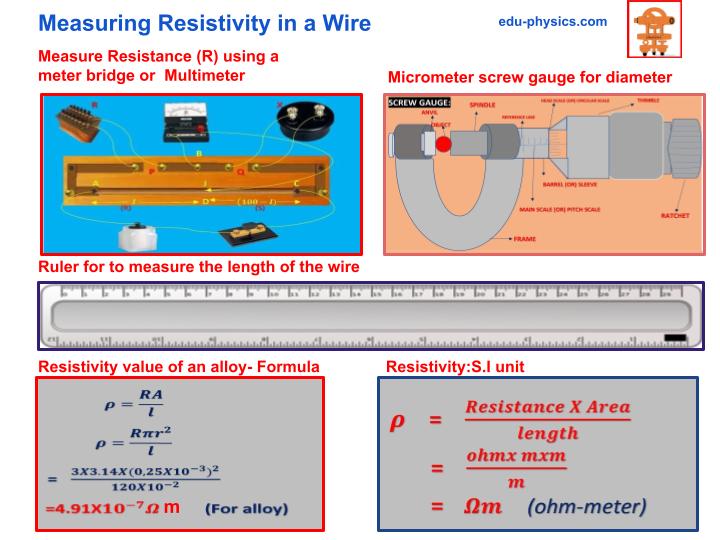
Measuring Resistivity in a Wire
Experimental determination of resistivity involves measuring resistance, length, and cross-sectional area.
Method:methodical approach: multimeter use
Determine the length (L) of the wire.
Calculate its diameter using a screw gauge and then its cross-sectional area (A = πr²) .
Multimeter is used to measure resistance (R).
Utilize the resistivity formula.
Method :methodical approach utilizing Ohm’s law
Setup the circuit:
Connect the power supply, voltmeter, ammeter, and test wire are needed to set up the circuit.
Measure the length:
Determine the wire’s length L. using a meter scale.
Measure the diameter:
Measure the diameter of the wire at several points with a micrometer screw gauge and thereby determine the area.
Change the current:
Rheostat is adjusted at various points and the current in the circuit is changed.Note the readings of voltmeter and ammeter for different current values of current.
Plot the graph:
To get the slope, which yields resistance (R), plot the V vs. I graph
Calculate the resistivity:
Calculate resistivity using ρ=R⋅A/L

Method: methodical approach;Using Meter bridge
Meter Bridge:
An electrical device called a meter bridge is used to determine a wire’s resistance.
Principle:
It operates on the basis of the Wheatstone bridge, a circuit consisting of four resistors coupled in a certain manner. The galvanometer does not experience any current flow when the bridge is balanced.
Setup the experiment:
Connect the resistors in accordance with the circuit design before using the meter bridge.Next, pick a known resistor from the resistance box and insert it into the bridge’s left arm.
To find unknown resistance:
The jockey is pressed close to ends A and B of the meter bridge wire once the circuit connections are finished. There is a circuit malfunction if the galvanometer’s deflections are on one side.
Checking the connection:
Check for double side deflections in the galvanometer.Until the galvanometer needle points to zero, move the jockey down the meter bridge wire. The jockey’s location is referred to as the balance point.The meter bridge resistance formula is used to determine the unknown resistance.
Wire’s radius and Area of cross section:
After determining the wire’s radius with a screw gauge, area A must be calculated.The provided wire is stretched, and its length has to be determined using a metre scale.
Calculate the resistivity:
We may determine the resistivity of the specified wire by using these data.For resistivity calculations, use ρ=R⋅A /L

Applications of Resistivity
Conducting Electricity:
A material’s resistivity indicates how well it conducts electricity:
Good conductors with low resistivity include copper, silver, and aluminum.
High resistivity: Poor conductor or insulator (e.g., rubber, glass, wood)
In practical applications:
To reduce power loss, we use low-resistivity materials in circuits and wires.
For insulation and resistance-based equipment (such as resistors and heaters), we employ high-resistivity materials.
Wiring for electricity:
Copper and other low-resistivity materials reduce energy loss during power transmission. Copper is utilized in both industrial and residential wiring because it is an excellent conductor.
Aluminum: Used in gearbox lines; lighter and less expensive.
Silver is the most expensive but best conductor.
Safety Equipment:
In order to identify overcurrent and cut the circuit, fuses and circuit breakers rely on resistivity.
Superconductors:
Zero-resistivity materials transform MRI scanners and maglev trains.
Miniature Electronic Devices:
Semiconductors like silicon and germanium, resistivity plays a crucial role in the working of:
Diodes
Transistors
Integrated Circuits (ICs)
Design of Heating Components:
In devices where heat generation from electrical resistance is needed, high resistivity wires, such as nichrome, are utilized.
Sensors:
Sensors that use resistivity include pressure and temperature sensors.
Material Science:
To investigate the characteristics of materials and create new materials with certain qualities, material science employs resistivity.
FAQs on Resistivity of a wire
Q:Is resistivity influenced by the wire’s size and shape?
Ans: No, resistivity is not affected by the size or shape of the wire. All that matters is the type of material.
Q:Which substance, at normal temperature, has the lowest resistivity?
Ans: At normal temperature, silver has the lowest resistance of any metal.
Q:Why are resistance wires made with constantan?
Ans: Constantan’s resistance is nearly constant with temperature changes due to its high resistivity and extremely low temperature coefficient of resistivity.
Q:What effect does alloying have on resistivity?
Ans: Because alloying adds more barriers to electron flow (such as manganin and constantan), resistivity typically rises.
Q:What role does resistivity play in electrical engineering?
Ans: Engineers can select the best materials for wires, resistors, heating elements, and other components depending on performance, cost, and safety by knowing the resistivity.
Q: What effect does doping have on semiconductor resistivity?
Ans: Doping, or adding impurities, boosts charge carriers while decreasing resistivity.
Q:Why is the resistance of superconductors zero?
Ans:The answer is that electron pairs, also known as Cooper pairs, flow without scattering below a threshold temperature.
Resistivity of a wire – Conclusion
In conclusion, the resistivity of a wire stands as a fundamental electrical property, intrinsic to the material itself.Unlike resistance, which depends on the wire’s dimension, resistivity offers a consistent measure of a materials inherent ability to impede the flow of electric current.
Understanding the factors influencing the resistivity such as the materials atomic structure and temperature, is crucial for selecting appropriate materials in diverse applications.From the classification of conductors,semiconductors and insulators to the practical methods of measurement and the varied technological uses, a comprehensive grasp of resistivity is essential for engineers,scientists and anyone seeking to understand the behaviour of electrical circuits and materials.The answers to frequently asked questions further solidify this understanding, highlighting the practical significance of this key electrical concepts.
Links to this topic
Resistivity of the material of a wire/Physics practical
Positive,and negative error in a screw gauge
Neet physics-Screw gauge practice questions
Laisser un commentaire