What is a screw gauge?
A screw gauge, also called a micrometer screw gauge, is a precision instrument for measuring small thicknesses and diameters, typically to 0.01 mm (0.001 cm). It works on the screw principle: a threaded spindle advances a fixed distance, the pitch, for every complete turn of the thimble. The circular scale splits that distance into many small, readable steps, so a tiny movement of the spindle becomes a large, easy-to-read movement along the thimble’s edge.
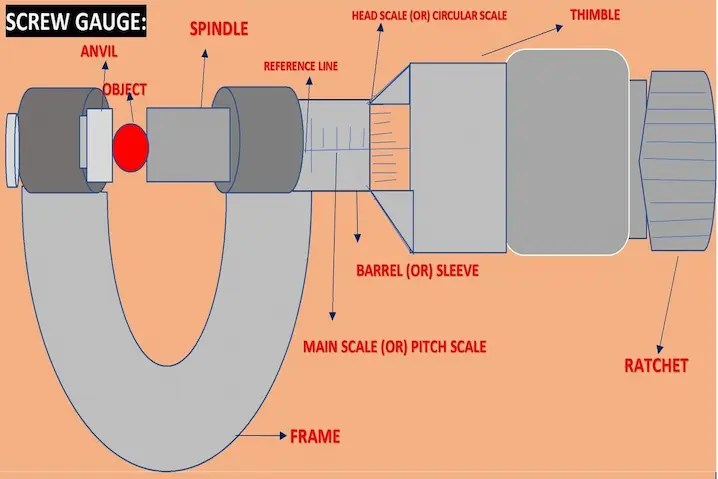
Parts of a screw gauge
| Part | Function |
| Frame | Rigid U-shaped body that holds the anvil and the sleeve |
| Anvil (stud) | Fixed end against which the object rests |
| Spindle | Movable screw end that presses on the object |
| Sleeve (barrel) with pitch scale | Linear main scale in mm, often with half-mm marks |
| Thimble with circular scale | Rotates over the sleeve; divided into N equal parts (head scale) |
| Ratchet | Slips at a set torque so every measurement uses the same gentle pressure |
| Lock nut | Locks the spindle so the reading can be noted safely |
Screw gauge formulas: quick-reference table
| Quantity | Formula | Notes |
| Pitch (p) | p = distance moved by spindle ÷ number of full rotations | Measured on the pitch scale, in mm |
| Least count (LC) | LC = p ÷ N | N = number of circular-scale divisions |
| Observed reading | PSR + (CSR × LC) | PSR = pitch scale reading; CSR = circular scale division at the index line |
| Positive zero error | e = +n × LC | n = division at the index line with jaws closed (n is small) |
| Negative zero error | e = −(N − n) × LC | n is close to N |
| Corrected reading | Observed reading − e | Subtract a positive error; add the size of a negative error |
| Cross-section of a wire | A = πd² ÷ 4 | d = corrected diameter |
| Maximum error in d | Δd = LC | The instrument’s resolution |
| Fractional error in A | ΔA ÷ A = 2Δd ÷ d | Useful in error-analysis questions |
Pitch of a screw gauge
Pitch is the distance the spindle moves along its axis during one complete rotation of the thimble. It equals the gap between adjacent threads of the screw. To measure it, give the thimble a known number of full turns, note how far the edge moved along the pitch scale, and divide. For example, if the edge moves 2 mm in 4 full turns, the pitch is 2 ÷ 4 = 0.5 mm.
Different instruments have different pitches. Many school lab screw gauges are 1 mm pitch with 100 divisions, but 0.5 mm pitch with 50 divisions is also common. Always measure or read the pitch; never assume it.

Least count of a screw gauge
The least count is the smallest length the instrument can resolve: LC = pitch ÷ number of circular-scale divisions.

| Pitch | Circular divisions (N) | LC (mm) | LC (cm) |
| 1 mm | 100 | 0.01 | 0.001 |
| 0.5 mm | 50 | 0.01 | 0.001 |
| 0.5 mm | 100 | 0.005 | 0.0005 |
| 1 mm | 50 | 0.02 | 0.002 |
A smaller least count means finer resolution. For a longer walk-through, see our guide to the [least count of a screw gauge].
How to read a screw gauge, step by step
- Note the pitch and least count of your instrument.
- Find the zero error. Close the jaws with the ratchet until it clicks and record the circular-scale reading at the index line.
- Place the object between the anvil and spindle and turn the ratchet until it clicks two or three times. Do not turn the thimble directly.
- Read the PSR: the last mark on the sleeve fully uncovered by the thimble (include a half-mm mark if your scale has one).
- Read the CSR: the circular-scale division that lines up with the index line.
- Calculate: observed reading = PSR + (CSR × LC), then apply the zero correction.
- Repeat at three places on the object and in two directions at right angles, and take the mean.
Zero error and zero correction
Zero error is the reading the instrument shows when the anvil and spindle touch and the true reading should be zero. Read it with the jaws closed:
- If the index line shows a small positive number of divisions n, the error is positive: e = +n × LC. The instrument reads too much, so subtract e.
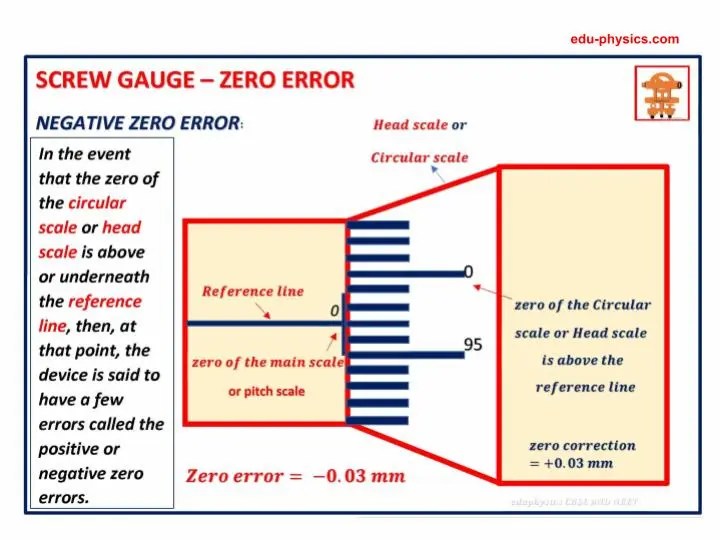
- If the index line shows a number close to N (for example 96 on a 100-division scale), the error is negative: e = −(N − n) × LC. The instrument reads too little, so add the size of e.
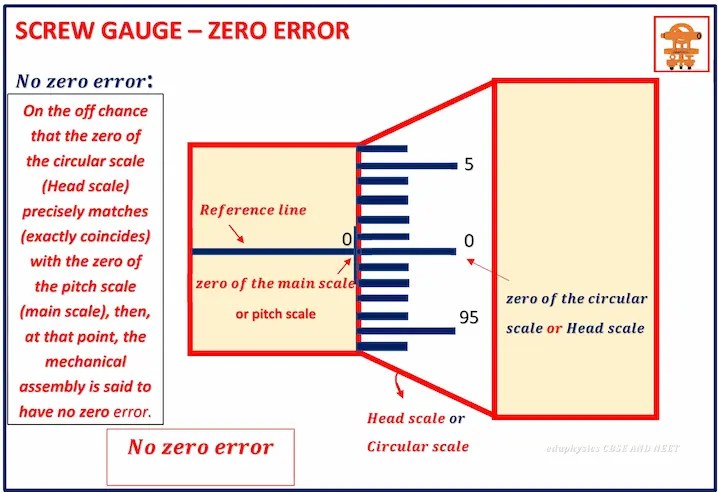
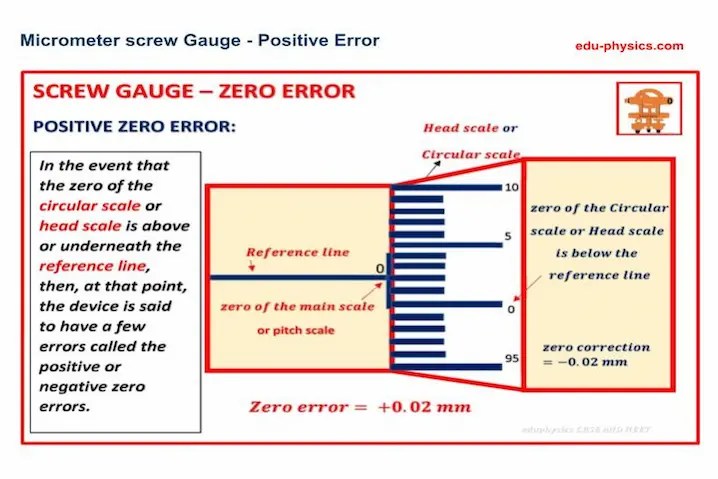
Worked example A: positive error. LC = 0.01 mm. Jaws closed, reading 3 divisions, so e = +0.03 mm. A wire gives PSR 1 mm and CSR 42, so observed = 1 + 42 × 0.01 = 1.42 mm. Corrected diameter = 1.42 − 0.03 = 1.39 mm.
Worked example B: negative error. LC = 0.01 mm, N = 100. Jaws closed, reading 96, so e = −(100 − 96) × 0.01 = −0.04 mm. A sheet gives PSR 2 mm and CSR 35, so observed = 2 + 0.35 = 2.35 mm. Corrected thickness = 2.35 − (−0.04) = 2.39 mm.
Memory tip: positive error means the reading is too big, so subtract. Negative error means the reading is too small, so add. More practice: [zero, positive and negative error in a screw gauge].
Solved numericals
1. Finding the least count. The spindle advances 2.5 mm in 5 full rotations and the circular scale has 50 divisions. Pitch = 2.5 ÷ 5 = 0.5 mm. LC = 0.5 ÷ 50 = 0.01 mm.
2. A simple reading. Pitch 1 mm, 100 divisions, PSR 4 mm, CSR 27, no zero error. Reading = 4 + 27 × 0.01 = 4.27 mm.
3. With positive zero error. Pitch 0.5 mm, N = 50, so LC = 0.01 mm. Jaws closed read 4 divisions, so e = +0.04 mm. Object: PSR 3.5 mm, CSR 18. Observed = 3.5 + 0.18 = 3.68 mm. Corrected = 3.68 − 0.04 = 3.64 mm.
4. With negative zero error. Pitch 1 mm, N = 100. Jaws closed read 94, so e = −(100 − 94) × 0.01 = −0.06 mm. Object: PSR 1 mm, CSR 58. Observed = 1.58 mm. Corrected = 1.58 + 0.06 = 1.64 mm.
5. Error in the cross-section. A wire has corrected diameter d = 1.39 mm and LC = 0.01 mm. Area A = πd² ÷ 4 = π × 1.9321 ÷ 4 ≈ 1.52 mm². Fractional error = 2 × 0.01 ÷ 1.39 ≈ 0.014 (1.4%). So A = 1.52 ± 0.02 mm².
For many more problems, see our [screw gauge numericals].
Uses of a screw gauge
| Field | What it measures |
| School and college physics labs | Diameter of a wire, thickness of a sheet, thickness of paper or a glass plate |
| Electrical work | Conductor diameter, which sets the cross-section needed for resistance and resistivity calculations |
| Machining and mechanical engineering | Small shafts, pins and components checked against tolerances |
| Sheet-metal work and jewellery | Thickness of foils, sheets and fine wire gauges |
| Quality control and metrology | Spot-checking parts against specification |
| Construction samples | Diameter of small rods and wire samples |
Limits: a standard screw gauge measures outside dimensions only, covers about 0–25 mm, and can squash soft materials if over-tightened.
Screw gauge vs vernier caliper
| Feature | Screw gauge | Vernier caliper |
| Principle | Screw and circular scale | Sliding vernier scale |
| Typical least count | 0.01 mm | 0.1 mm (0.01 cm) for common school versions |
| Typical range | About 0–25 mm | Up to 15 cm or more |
| Best for | Wire diameter, sheet thickness | Cylinder diameters, inside diameters, depth |
| Inside or depth measurement | Not with the standard type | Yes |
| Main error sources | Zero error, backlash, over-tightening | Zero error, parallax |
Errors and precautions
- Zero error: always measure it and correct every reading.
- Backlash error: looseness between screw and nut shows up when the turning direction is reversed. Turn the thimble in one direction only while taking a reading.
- Excess pressure: use the ratchet. Stop at the click.
- Uneven wire: measure at several places and in two perpendicular directions, then average.
- Parallax: read the scales at eye level.
- Dirt: wipe the anvil and spindle faces before closing the jaws.
Exam corner: CBSE, NEET and JEE
Q1. A screw gauge has pitch 1 mm and 100 divisions. Its least count is: (a) 0.1 mm (b) 0.01 mm (c) 0.001 mm (d) 0.5 mm. Answer: (b).
Q2. With jaws closed, the 5th division of the circular scale is at the index line (LC 0.01 mm). The zero correction is: (a) +0.05 mm (b) −0.05 mm (c) +0.5 mm (d) −0.5 mm. Answer: (b).
Q3. On a 100-division scale the closed reading is 94 (LC 0.01 mm). The zero error is: (a) +0.06 mm (b) −0.06 mm (c) +0.94 mm (d) −0.94 mm. Answer: (b).
Q4. Pitch 0.5 mm, 50 divisions, PSR 3 mm, CSR 27, zero error −0.03 mm. The true reading is: (a) 3.24 mm (b) 3.27 mm (c) 3.30 mm (d) 3.57 mm. Answer: (c).
Q5. The ratchet is used to: (a) magnify the reading (b) apply uniform pressure (c) lock the spindle (d) adjust the zero. Answer: (b).
Q6. A diameter of 2.50 mm is measured with LC 0.01 mm. The percentage error in the cross-section area is about: (a) 0.4% (b) 0.8% (c) 1.0% (d) 1.6%. Answer: (b), since 2 × 0.01 ÷ 2.50 = 0.8%.
Viva questions: Why is it called a screw gauge? What is backlash and how do you avoid it? Why use the ratchet? What happens to the least count if N doubles? Does the zero error stay the same for all time?
More practice: [NEET screw gauge questions].
Frequently asked questions
What is the principle of a screw gauge? It converts a small linear movement of a screw into a large, easily read rotation. One full turn moves the spindle by the pitch, and the circular scale divides that into many steps.
What are the main parts of a screw gauge? Frame, anvil, spindle, sleeve with the pitch scale, thimble with the circular scale, ratchet and lock nut. Each function is listed in the table above.
What is the least count of a screw gauge and how is it calculated? It is the smallest length the instrument can read: pitch divided by the number of circular-scale divisions. For example, 0.5 mm ÷ 50 = 0.01 mm.
What is the screw gauge formula? Reading = PSR + (CSR × LC). PSR is the pitch scale reading, CSR is the circular scale division at the index line, and LC is the least count. Then subtract the zero error.
How do the pitch scale and circular scale work together? The pitch scale gives whole pitch units (mm or half mm). The circular scale gives the fraction of one pitch, in multiples of the least count.
Besides diameter and thickness, what else can it measure? Thin foils and paper, and with extra calculation, the cross-section area of a wire and the volume of a thin lamina.
Is least count the same as accuracy? No. Least count is the instrument’s resolution. Accuracy also depends on zero error, calibration and how carefully the instrument is used.
Is the pitch always 1 mm? No. Many lab instruments use 1 mm, but 0.5 mm is also common. Measure it before you start.
What do I do if the zero error is positive? Subtract the zero error from every observed reading. For a negative error, add its size.
You must be logged in to post a comment.