Interference:Definition
The phenomenon by which intensity is redistributed when two light waves from two coherent sources superpose each other to form a resultant wave of greater,or lower or of the same amplitude.

Principle
Based on the principle of superposition (Amplitudes of interfering waves add algebraically).
Types of Interference
Constructive Interference:
It is the process by which waves combine their amplitudes to create a louder or brighter wave when they are in phase (crest to crest).
Destructive Interference:
When waves meet out of phase (the crest and trough line up), their amplitudes cancel each other out, making the wave quieter or dimmer.
Conditions for interference:
The waves must be coherent (have a constant phase difference)
They ought to share the same frequency and wavelength.
There must be spatial overlap between the waves.
Interference Examples
Young’s experiment:
Also known as the double-slit experiment, shows how light passing through two slits produces an interference pattern of dark and bright fringes.
Thin-film Interference:
Light waves reflecting off various surfaces interfere to produce the colors seen in oil slicks and soap bubbles.
Noise canceling headphones:
Headphones block out unwanted sound waves by using destructive interference.
DIFFRACTION:
Definition
Diffraction is due to the superposition of secondary wavelets originating from different parts of the same wavefront.
Principle:
Based on the principle of Huygens wavelets, where each point on a wavefront acts as a source of secondary wavelets.
Key characteristics of diffraction:
Diffraction pattern is more pronounced when a wave from a source encounters a slit ,that is comparable in size to its wavelength,as shown in the below diagram.
Causes waves to disperse and create patterns (spectra are produced by diffraction gratings, for example).
Causes waves to disperse and create patterns (spectra are produced by diffraction gratings, for example).

Types of diffraction:
Fresnel diffraction:
When the source and screen are at finite distances from the obstruction, Fresnel Diffraction (also known as near-field diffraction) takes place.
Fraunhofer diffraction:
When the source and screen are practically at infinite distances, diffraction takes place (far-field diffraction).
Diffraction examples:
DVD/CD Rainbow Effect:
Light is divided into colors by the microscopic grooves, which function as a diffraction grating.
Sound Bending Around Corners:
Because sound waves diffract, you can hear someone talking even if they are surrounded by a wall.
X-Ray crystallography:
Used to determine atomic structures by analyzing diffraction patterns of X-rays passing through crystals.

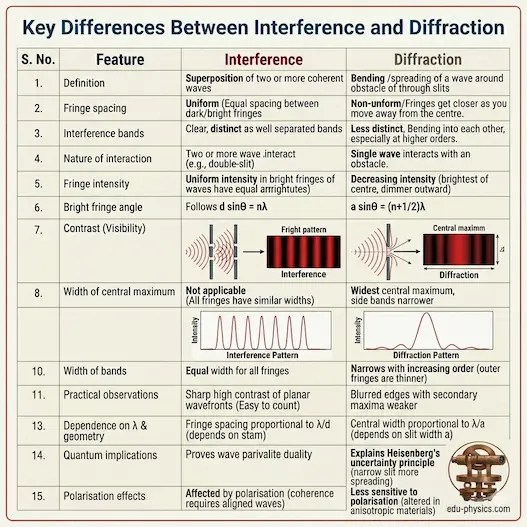
Key Differences Between Interference and Diffraction
Common Misconceptions:
Diffraction is the same as interference. False
Reality: Although they are connected, they are two different phenomena. Diffraction is the bending of a single wave, whereas interference involves several waves. -True
Diffraction is limited to light -False
Reality: All waves, including sound and water waves, undergo diffraction.Accurate
Two distinct sources are always needed for interference. -False
Reality: A single source that splits into two coherent waves can cause interference (double-slit experiment, for example). -True
Real-World Applications:
Applications for Interference
Holography:
Produces three-dimensional images by using interference patterns.
Anti-Reflective Coatings:
Thin films cause destructive interference to reduce glare.
Radio Telescopes (Interferometry)
Combines signals from multiple telescopes to enhance resolution.
Applications for Diffraction:
Spectrometers:
To examine light spectra, use diffraction grating.
Acoustic diffraction:
Designing concert halls for improved sound distribution is made easier by acoustic diffraction.
Electron Diffraction:
Materials scientists use electron diffraction to study crystal structures.
Conclusion
Two intriguing wave phenomena that illustrate the wave nature of sound and light are interference and diffraction. Although they are similar in that they both create wave patterns, their underlying mechanisms are very different.
When two or more coherent waves superimpose, interference occurs.
Bending a single wave around obstructions or through gaps is known as diffraction.
Applications ranging from quantum physics to optical engineering require an understanding of these distinctions. You’ll be able to tell if diffraction or interference is at work the next time you see a rainbow on a CD or hear sound bending around a corner!
Leave a Reply