Bernoulli’s Principle
The most visual chapter in fluid mechanics. Master it from intuition to exam-ready formulas — all in one place.
P + ½ρv² + ρgh = constant
✈️ Why planes fly
Fast air above wing creates lift
🏏 Cricket swing
Seam creates pressure difference
🌪️ Roofs fly off

Fast wind = low pressure outside
40Solved Problems
30MCQ Questions
12Applications
NEET+ JEE Ready
Questions Before Formulas
All these mysteries are solved by ONE principle. Build curiosity before theory!
Aviation
✈️ How does a 500-ton plane fly?
Air moves faster over the curved upper wing → lower pressure above → atmospheric pressure below pushes plane UP with enormous lift force!
Cricket
🏏 Why does a cricket ball swing?
The rough seam on one side creates turbulence → different air speeds on each side → pressure difference → ball curves in air!
Weather
🌪️ Why do roofs fly off in storms?
Fast wind above the roof → very low pressure outside. Normal pressure inside the house → net force pushes roof UPWARD and outward!
Daily Life
🌸 How does a perfume atomizer work?
Squeeze the bulb → fast air stream above the tube → low pressure at tube top → perfume rises and breaks into fine mist!
Physics
💧 Why do lower holes throw water farther?
Greater depth = greater pressure = faster efflux speed. But lower height means less time to fall. Maximum range is at middle height!
Transport
🚂 Why does a fast train pull you toward it?
Train creates region of very fast-moving air → low pressure zone nearby → surrounding higher-pressure air pushes you toward the train!
⚡ The Golden Rule: Fast Flow → Low Pressure | Slow Flow → High Pressure
🧠 Memory Trick: Think of “FAST = FLAT” — fast-moving fluid has a flat (low) pressure, like a fast runner who’s always low on energy!
What is a Fluid?
💧 Liquids
Water, blood, oil, mercury. Fixed volume but no fixed shape. Incompressible for most purposes.
💨 Gases
Air, steam, helium. No fixed volume or shape. Compressible at high speeds.
🌊 Key Property
Fluids flow and take the shape of their container. They transmit pressure in all directions (Pascal’s Law).
Streamline vs Turbulent

Before Bernoulli, understand the two ways a fluid can behave when it moves.
✅ Streamline (Laminar) Flow
Every fluid particle follows a smooth, fixed path. Layers slide past each other without mixing. Velocity at any point stays constant over time.
Orderly and predictable
Low velocity, no energy waste
Bernoulli’s theorem applies here
Honey flowing
Blood in arteries
Slow river
❌ Turbulent Flow
Chaotic, irregular motion. Particles form eddies and vortices. Significant energy is wasted as heat and sound.
Random and unpredictable
High velocity, high energy loss
Bernoulli does NOT apply
Flooded river
Smoke from fire
Air turbulence
Reynolds Number — The Flow Predictor
Re = ρvD / η
| Symbol | Quantity | SI Unit |
|---|---|---|
| ρ | Fluid density | kg/m³ |
| v | Flow velocity | m/s |
| D | Pipe diameter | m |
| η | Dynamic viscosity | Pa·s |
| Re < 1000 | → Streamline (Laminar) flow | |
| Re > 2000 | → Turbulent flow (chaotic) | |
| 1000–2000 | → Transition zone (unpredictable) | |
Energy in Flowing Fluids
Every fluid particle carries three types of energy. Bernoulli says their total is always the same along any streamline.
🔵 Pressure Energy P
Due to the force that fluid exerts on its surroundings. Units: Pa = J/m³
🟡 Kinetic Energy ½ρv²
Due to the motion of the fluid. Increases when fluid speeds up in a narrow pipe.
🟢 Potential Energy ρgh
Due to the height of the fluid above a reference level. Decreases as fluid flows downhill.
Continuity Equation
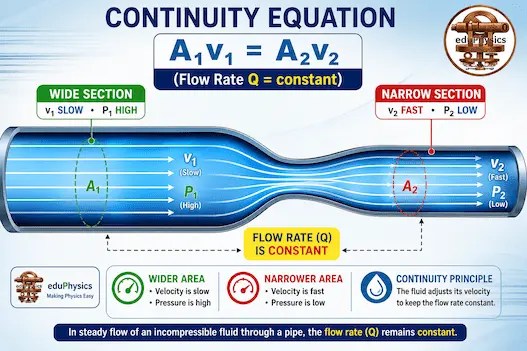
For incompressible fluid: whatever mass enters must exit. If pipe narrows, speed MUST increase!
A₁v₁ = A₂v₂ (Flow Rate Q = constant)
WIDE SECTION
v₁ slow · P₁ HIGH
NARROW SECTION
v₂ FAST · P₂ LOW
🚗 Road Analogy:
Wide road = slow traffic
Narrow road = fast traffic
Bernoulli’s Principle
Daniel Bernoulli, 1738
“For an ideal fluid in steady flow along a streamline, the sum of pressure energy, kinetic energy per unit volume, and potential energy per unit volume is constant.”
Physical Intuition — The Energy Budget 💰
Think of each fluid molecule as carrying a fixed budget of energy. It has three accounts: Pressure, Speed, Height. The total budget never changes. If it spends more on speed (moves faster), pressure account must go down!
Point 1 (wide, slow)
P₁ HIGH ½ρv₁² low ρgh₁
flow → TOTAL = const
Point 2 (narrow, fast)
P₂ LOW ½ρv₂² HIGH ρgh = Same total!
Pressure Kinetic Potential
Assumptions — NEET/JEE Important!
| Assumption | What It Means | Why Needed |
|---|---|---|
| Ideal fluid | Zero viscosity (no internal friction) | Otherwise energy is lost to heat |
| Incompressible | Density ρ is constant | Valid for liquids; not for fast gases |
| Steady flow | Velocity at each point is time-independent | Otherwise energy changes with time |
| Along streamline | Applies only along one path | Different streamlines can have different constants |
| Non-rotational | No vortices or spinning in flow | Turbulent flow violates this |
❌ Misconception: “Bernoulli’s principle works for all fluids in all situations.”
✅ Reality: Only for ideal (non-viscous), incompressible, steady, irrotational flow. Real fluids always need correction factors!
Equation & Derivation
P₁ + ½ρv₁² + ρgh₁ = P₂ + ½ρv₂² + ρgh₂
Derivation (Work-Energy Theorem — Step by Step)
We derive Bernoulli’s equation for a fluid element moving from point 1 (wide section, low) to point 2 (narrow section, high). The fluid is ideal and incompressible.
1 Work done BY pressure at inlet (point 1)
Force = P₁A₁, distance pushed = Δx₁, so W₁ = P₁A₁Δx₁ = P₁ΔV (positive — fluid is pushed in)
2 Work done AGAINST pressure at outlet (point 2)
Fluid must push outward against P₂, so W₂ = −P₂A₂Δx₂ = −P₂ΔV (negative — opposes flow)
3 Work done against gravity
Mass element = ρΔV, height gain = (h₂−h₁): W_gravity = −ρΔVg(h₂−h₁)
4 Apply Work-Energy Theorem: W_net = ΔKE
P₁ΔV − P₂ΔV − ρΔVg(h₂−h₁) = ½ρΔV(v₂² − v₁²)
5 Divide by ΔV and rearrange
P₁ + ½ρv₁² + ρgh₁ = P₂ + ½ρv₂² + ρgh₂ ✓
This is Bernoulli’s Equation — it’s simply conservation of energy per unit volume!
Special Cases
Horizontal Pipe (h₁ = h₂)
P + ½ρv² = constant
Most common exam case. When velocity increases, pressure decreases proportionally.
Fluid at Rest (v = 0)
P + ρgh = constant
This is Pascal’s Law for hydrostatics! Bernoulli reduces to it for still fluids.
Pressure Terms
| Type | Formula | Physical Meaning |
|---|---|---|
| Static pressure | P |
Force per unit area due to fluid weight |
| Dynamic pressure | ½ρv² |
Pressure due to fluid motion |
| Hydrostatic pressure | ρgh |
Pressure due to depth/height |
| Total (Bernoulli sum) | P + ½ρv² + ρgh |
= constant along streamline |
🧠 Dimensional check: P = N/m² = J/m³. Also ½ρv² = (kg/m³)(m²/s²) = J/m³. And ρgh = J/m³. All three terms have the same dimension — they’re all energy per unit volume!
Live Simulator
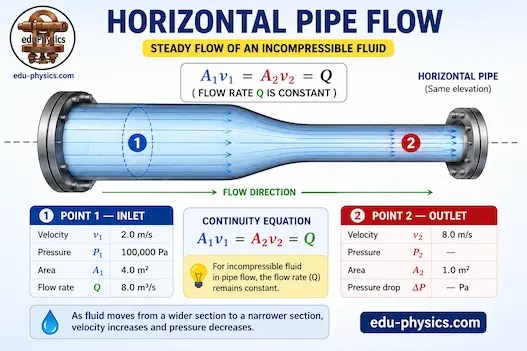
Adjust the sliders and watch Bernoulli’s equation work in real time!
🔬 Horizontal Pipe Flow — Bernoulli Simulator
2.0
4.0
1.0
1000
🔵 Point 1 — Inlet
Velocity v₁2.0 m/s
Pressure P₁100,000 Pa
Area A₁4.0 m²
Flow rate Q8.0 m³/s
🔴 Point 2 — Outlet
Velocity v₂8.0 m/s
Pressure P₂—
Area A₂1.0 m²
Pressure drop ΔP— Pa
🌊 Torricelli Simulator — Efflux Speed

5.0
10.0 Efflux Results
Efflux speed v10.0 m/s
Hole height from ground5.0 m
Projectile Results
Time to ground t1.0 s
Horizontal range x10.0 m
Applications of Bernoulli
✈️
Aviation
Airplane Wing (Aerofoil)
Curved upper surface → air travels faster → lower pressure above. Flat lower surface → slower air → higher pressure. Net upward force = LIFT! F = ½ρ(v₂²−v₁²)×A
🏏 Cricket
Swing Bowling
Ball’s rough seam creates turbulence on one side → different air speeds → pressure difference → sideways force. Bowlers polish one side to maximize swing!
🌸 Daily Life
Perfume Atomizer
Squeeze bulb → high-speed air across tube top → low pressure → atmospheric pressure pushes liquid up → atomized into fine mist. Same as carburetor!
🏠 Weather
Storm Roof Damage
Fast wind above roof → low pressure outside. Normal atmospheric pressure inside. Net force = outward (upward on roof). This is why roofs fly off in hurricanes!
🏭 Engineering
Chimney Draft
Wind over chimney top → low pressure. Higher pressure inside at base. Pressure difference sucks smoke upward. Taller chimneys work better for this reason!
⚙️ Engines
Carburetor
Air forced through venturi throat → very high speed → very low pressure → fuel sucked from fuel bowl → perfect fuel-air mixture enters cylinder. Used in older vehicles!
🩺 Medicine
Blood Circulation
Narrow (blocked) arteries → blood speeds up → lower pressure → artery walls may collapse inward. This is the Bernoulli mechanism behind arterial blockage!
🏎️ F1 Racing
Formula 1 Downforce
Inverted aerofoil on F1 car creates fast air BELOW → low pressure below → car is sucked DOWN. This “downforce” allows 6G cornering at high speeds!
Aircraft Lift — Detailed Physics
FAST air above → LOW pressure (P₂)
SLOW air below → HIGH pressure (P₁)
LIFT ↑
Aerofoil (wing cross-section)
F_lift = (P₁ − P₂) × A_wing = ½ρ(v_above² − v_below²) × A
Torricelli & Venturi
Torricelli’s Law — Speed of Efflux
A tank with a small hole at depth h below the water surface. What is the speed of water emerging from the hole?
1 Apply Bernoulli from surface (1) to hole (2)
Both at atmospheric pressure P_atm. Surface is at height H, hole at height (H−h).
2 Since tank is large, v_surface ≈ 0
P_atm + 0 + ρgH = P_atm + ½ρv² + ρg(H−h)
3 Simplify → ρgh = ½ρv²
v = √(2gh)
🧠 Amazing Connection: v = √(2gh) is identical to the speed of an object dropped from height h! The fluid from the hole is “falling” through the pressure difference just like a dropped ball falls through gravity!
Range of Efflux (Projectile Analysis)
x = √[4h(H−h)]
✅ Maximum range when h = H/2 (hole at middle)
x_max = √[4 × (H/2) × (H/2)] = √(H²) = H
❌ Common Error: Thinking the bottom hole gives max range. It gives max speed but zero height → zero range. Both extremes (top and bottom) give zero range!
Venturi Meter — Measuring Flow Speed
A Venturi meter is a pipe with a gradual narrowing (throat). By measuring pressure difference between wide and narrow sections, we can calculate flow velocity.
Wide (1)
Throat (2)
Wide again
Manometer: measures ΔP = P₁ − P₂
P₁ (high)
P₂ (low)
v₂ = A₁√[2(P₁−P₂) / ρ(A₁²−A₂²)]
Q = A₂v₂ (Volume flow rate)
🧠 JEE Trick: For mercury manometer, effective ΔP = g × h_Hg × (ρ_Hg − ρ_fluid). Don’t forget to subtract the fluid density from mercury density!
Blood Flow & Magnus Effect
Blood Flow and Bernoulli — Why Heart Attacks Happen
✅ Healthy Artery
Wide lumen — blood flows at normal speed
Normal blood pressure on walls
Artery remains open and stable
Heart pumps efficiently
❌ Cholesterol-Blocked Artery
Narrow lumen → blood must speed UP (continuity)
Faster blood → LOW pressure inside (Bernoulli)
Artery walls collapse INWARD due to pressure difference
Complete blockage → Myocardial infarction (heart attack)!
⚠️ The Bernoulli Paradox in Medicine: You’d expect high pressure to cause the blockage. But it’s actually FAST blood creating LOW pressure that makes the artery walls collapse. This is called the “Venturi effect in arteries”!
💉 Blood Pressure Measurement
Normal: 120/80 mmHg. Systolic (120) = peak pressure when heart contracts. Diastolic (80) = resting pressure. Values measured in the brachial artery (upper arm) as a reference point. High BP strains artery walls and can cause rupture (stroke/aneurysm).
Magnus Effect — Why Spinning Balls Curve
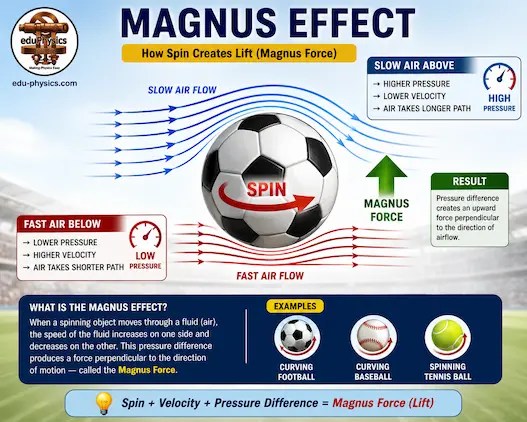
When a ball spins, it drags air with it. This creates faster air on one side and slower on the other → pressure difference → curved path!
⟳
SPIN
FAST air below → LOW pressure
SLOW air above → HIGH pressure
Magnus Force
Curved path
🏏 Cricket
Swing bowling — rough seam creates turbulence → differential air speed → swing
⚽ Football
Free kick “banana” curve — ball spins and bends around the defensive wall
🎾 Tennis
Topspin — ball dips sharply into the court due to downward Magnus force
40 Solved Numericals
Easy → Moderate → NEET/JEE. Click “Reveal Solution” to check each answer!
MCQ Practice
Click any option to instantly see if you’re right — with full explanations!
Rapid Revision
📋 Complete Formula Sheet
Bernoulli’s equationP + ½ρv² + ρgh = constantAll fluid flow problems
Continuity equationA₁v₁ = A₂v₂Velocity in different sections
Torricelli’s lawv = √(2gh)Speed of efflux from tank
Range of effluxx = √[4h(H−h)]Horizontal distance; max at h=H/2
Reynolds numberRe = ρvD / ηRe<1000: laminar, Re>2000: turbulent
Dynamic liftF = ½ρ(v₂²−v₁²) × AAircraft, wings, F1 cars
Venturi flow rateQ = A₁A₂√[2ΔP/ρ(A₁²−A₂²)]Venturi meter measurement
Critical velocityv_c = Re_c × η / (ρD)Onset of turbulence
Dynamic pressureq = ½ρv²Pitot tube, Bernoulli term
🧠 Memory Tricks Summary
⚡ FAST = LOW pressure — like a fast runner always low on energy (pressure runs out when speed goes up!)
🕳️ Torricelli = Free Fall — v = √(2gh) is identical to free fall from height h. The hole “drops” fluid at free-fall speed!
✈️ FAST AIR ABOVE = plane flies — curved wing → fast air → low P above → atmospheric pressure below lifts the plane!
🩸 NARROW → FAST → LOW P → COLLAPSE — the chain that explains arterial blockage and heart attacks!
❌ Common Misconceptions — FIXED!
❌ “Faster fluid always has higher pressure” → WRONG! Bernoulli says EXACTLY the opposite. Faster = LOWER pressure!
❌ “Aircraft fly ONLY because of Bernoulli” → WRONG! Newton’s 3rd law (reaction force from air deflection downward) also contributes significantly to lift!
❌ “Bernoulli works for all fluids” → WRONG! Only ideal (non-viscous), incompressible, steady, non-turbulent flow!
❌ “Bottom hole of tank always gives maximum range” → WRONG! Bottom gives maximum speed but zero height → range = 0. Middle gives maximum range!
🎯 NEET vs JEE Focus
NEET Priority
Torricelli’s theorem — efflux speed calculations
Bernoulli at two points — pressure difference
Dynamic lift on aircraft wing
Magnus effect — why balls curve
Blood flow and Bernoulli (biology crossover!)
JEE Priority
Venturi meter — full derivation
Range of efflux with optimization
Bernoulli + continuity combined problems
Reynolds number — critical velocity
Assertion-Reason conceptual questions
📐 Dimensional Analysis Quick Check
| Term | SI Unit | Dimension |
|---|---|---|
| P (pressure) | Pa = N/m² = J/m³ | [M L⁻¹ T⁻²] |
| ½ρv² (dynamic pressure) | J/m³ | [M L⁻¹ T⁻²] |
| ρgh (hydrostatic) | J/m³ | [M L⁻¹ T⁻²] |
| All three terms | Same! J/m³ | Same dimension ✅ Equation is dimensionally consistent! |
🔗 Assertion-Reason (JEE Type)
A: A spinning cricket ball curves in air.
R: Spinning creates different air speeds on two sides, causing a pressure difference (Magnus effect).
✅ Answer: Both A and R true; R correctly explains A.
A: Velocity of efflux from a tank is √(2gh).
R: This equals the velocity of an object freely falling from the same height h.
✅ Answer: Both A and R true; R correctly explains A.
Leave a Reply