
Class 12/Wave Optics/NEET and JEE study Materials
Introduction
Light is an electromagnetic wave that exhibits several important wave phenomena, including reflection, refraction, diffraction, polarisation, and interference. Among these, interference of light provides strong evidence for the wave nature of light.
Interference occurs when two or more light waves overlap in a region of space and produce a redistribution of light intensity. This results in regions of maximum and minimum intensity, depending on the phase relationship between the waves.
For a stable and clearly observable interference pattern, the sources of light must be coherent. Therefore, understanding coherent sources and the principle of superposition is essential for studying interference.
This topic is important for CBSE Class 12 Physics, NEET, and JEE examinations.
1. Coherent Sources of Light
Two sources of light are said to be coherent sources if they emit light waves of the same frequency and maintain a constant phase difference.
The constant phase difference ensures that the relative positions of the crests and troughs of the two waves do not change randomly with time.
Characteristics of coherent sources
The important characteristics of coherent sources are:
- They emit light waves of the same frequency.
- They maintain a constant phase difference.
- Their phase relationship remains stable over the observation time.
- They can produce a stable interference pattern when their waves overlap.
- For clearly visible fringes, the interfering waves should have comparable amplitudes.
How are coherent sources produced?
Two independent ordinary light sources generally do not maintain a constant phase difference because light is emitted through independent atomic processes.
Coherent sources are commonly obtained by splitting light from a single source into two or more waves. These waves retain a stable phase relationship under suitable conditions.
Examples include:
- Light beams obtained by splitting a laser beam.
- Secondary light sources derived from the same original source.
- Coherent beams used in optical interferometers.
Important point: Two sources having the same frequency are not necessarily coherent. They must also maintain a constant phase difference.

2. Incoherent Sources of Light
Two sources are called incoherent when the phase difference between their emitted waves changes randomly with time.
Ordinary independent light bulbs are examples of incoherent sources.
Although their emitted light may contain the same range of frequencies, the relative phase of their waves does not remain fixed.
Consequently, any instantaneous interference pattern fluctuates rapidly and generally cannot be observed as a stable pattern with ordinary detectors.
Difference between coherent and incoherent sources
| Coherent sources | Incoherent sources |
| Have the same frequency for ideal monochromatic waves | May have the same or different frequencies |
| Maintain a constant phase difference | Have a randomly varying phase difference |
| Can produce a stable interference pattern | Do not normally produce a stable interference pattern |
| Commonly derived from a common source | Often consist of independent light sources |
3. Interference of Light

Interference of light is the phenomenon in which two or more coherent light waves superpose and produce a redistribution of intensity.
Depending on the phase difference between the waves, the resultant intensity may increase or decrease.
The two principal types of interference are:
- Constructive interference.
- Destructive interference.
Interference does not create or destroy energy. Instead, it redistributes the light energy among different regions.
4. Principle of Superposition of Light Waves
The principle of superposition states that when two or more light waves meet at a point, the resultant electric field is the vector sum of the individual electric fields.
For two waves with electric fields E₁ and E₂:
Resultant electric field = E₁ + E₂
The observed intensity depends on the resultant electric field and on the phase relationship between the waves.
For two coherent waves of intensities, I₁ and I₂, the resultant intensity is:
I = I₁ + I₂ + 2√(I₁I₂) cos φ
Here:
- I is the resultant intensity.
- I₁ and I₂ are the intensities of the individual waves.
- φ is the phase difference between the waves.
- cos φ determines the contribution of interference.
The final term is called the interference term. It explains why the resultant intensity can be greater or smaller than the sum of the individual intensities.
5. Constructive Interference
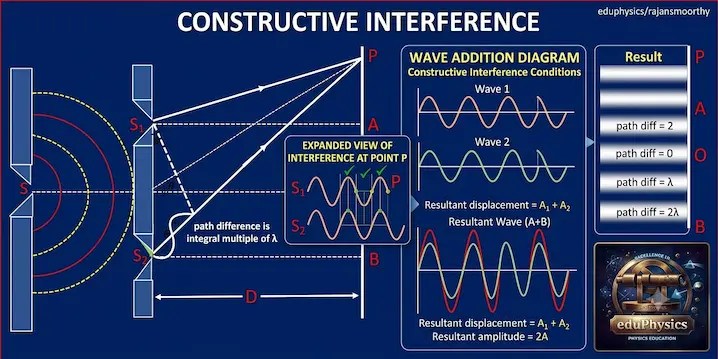
Constructive interference occurs when two coherent light waves meet in the same phase or with a phase difference equal to an integral multiple of 2π.
The crests of the waves coincide with crests, and the troughs coincide with troughs. The resultant amplitude is therefore maximum.
Conditions for constructive interference
The phase difference must be:
φ = 2nπ
The corresponding path difference is:
Δ = nλ
where:
- Δ is the path difference.
- λ is the wavelength of light.
- n = 0, ±1, ±2, ±3, …
Resultant intensity
The maximum intensity is:
Imax = (√I₁ + √I₂)²
If both waves have equal intensity I₀:
Imax = 4I₀
Thus, for equal-intensity waves, constructive interference produces an intensity four times the intensity due to either wave individually.
6. Destructive Interference
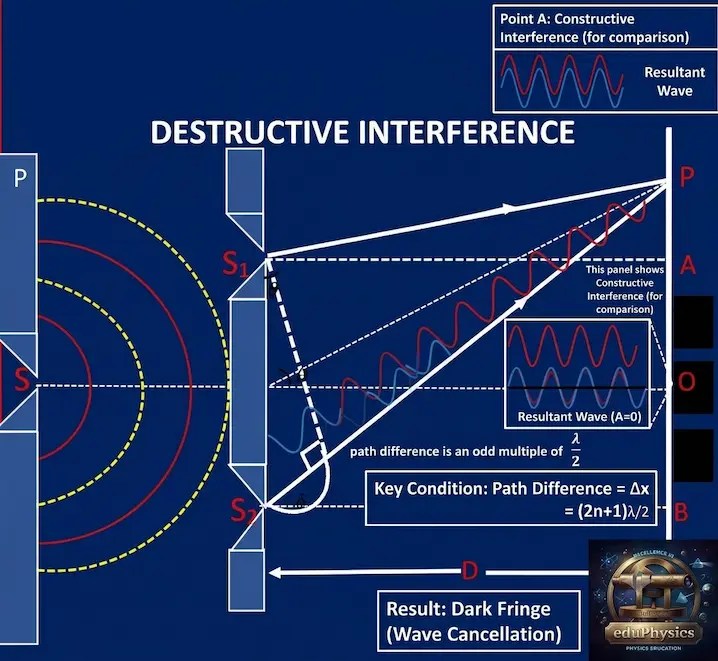
Destructive interference occurs when two coherent light waves meet with a phase difference equal to an odd multiple of π.
The crest of one wave coincides with the trough of the other. The resultant amplitude is reduced and may become zero.
Conditions for destructive interference
The phase difference must be:
φ = (2n + 1)π
The corresponding path difference is:
Δ = (n + 1/2)λ
where n = 0, 1, 2, 3, …
Resultant intensity
The minimum intensity is:
I min = (√I₁ − √I₂)²
For waves of equal intensity:
I min = 0
Therefore, complete destructive interference occurs when the waves have equal amplitudes and are exactly out of phase.
If the amplitudes are unequal, complete cancellation does not occur, and the minimum intensity remains greater than zero.
7. Phase Difference and Path Difference
Phase difference and path difference are closely related quantities used to describe interference.
The phase difference represents the difference in phase between two waves at a particular observation point.
The path difference represents the difference between the distances travelled by the two waves to reach that point, taking the relevant propagation conditions into account.
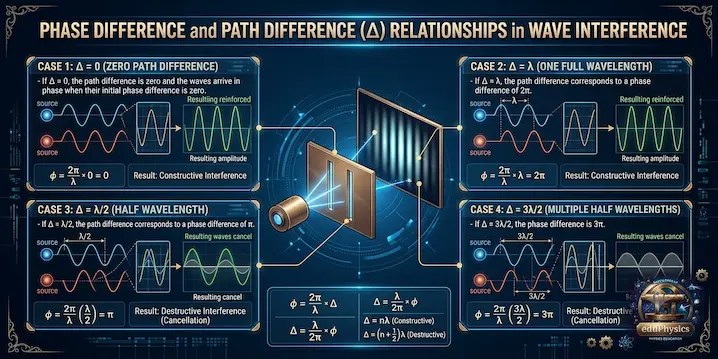
For two waves travelling in the same medium:
φ = 2πΔ/λ
where:
- φ is the phase difference in radians.
- Δ is the path difference.
- λ is the wavelength in that medium.
Important relationships
- If Δ = 0, the path difference is zero and the waves arrive in phase when their initial phase difference is zero.
- If Δ = λ, the path difference corresponds to a phase difference of 2π.
- If Δ = λ/2, the path difference corresponds to a phase difference of π.
- If Δ = 3λ/2, the phase difference is 3π.
For waves that begin with a non-zero phase difference, the total phase difference also depends on their initial relative phase.
8. Conditions Necessary for Sustained Interference
A clear and stable interference pattern requires the following conditions:
1. Coherence
The sources must maintain a constant phase difference over the observation time.
2. Same frequency
The interfering waves should have the same frequency. For ordinary sustained interference, this is an essential requirement.
3. Comparable amplitudes
For clearly visible bright and dark regions, the amplitudes of the waves should be comparable. Equal amplitudes allow complete cancellation at destructive-interference points.
4. Same state of polarisation
The electric fields should have compatible polarisation directions. Mutually perpendicular polarisation states do not produce the usual interference term in an ordinary intensity measurement.
5. Spatial overlap
The waves must overlap in the region where interference is to be observed.
6. Stable experimental conditions
Changes in the optical paths, source positions, or relative phase should not be so rapid that they wash out the interference pattern during observation.
9. Intensity Distribution Due to Interference
The resultant intensity depends on the phase difference between two coherent waves.
For two waves of equal intensity, I₀:
I = 4I₀ cos²(φ/2)
This equation describes the variation of intensity with phase difference.
When φ = 0, 2π, 4π, and so on, the intensity is maximum.
When φ = π, 3π, 5π, and so on, the intensity is minimum and becomes zero for equal-amplitude waves.
At intermediate phase differences, the intensity takes values between the maximum and minimum.
This relationship is fundamental to optical interference and is used in optical instruments, thin-film systems, and interferometers.
10. Applications of Interference of Light
Interference has several important scientific and technological applications.
1. Measurement of wavelength
Interference techniques can be used to determine the wavelength of light accurately.
2. Measurement of very small distances
Optical interferometers can measure minute changes in distance, displacement, and surface position.
3. Testing optical surfaces
Interference patterns help detect irregularities and imperfections in optical components such as lenses and mirrors.
4. Anti-reflection coatings
Thin-film interference is used in coatings that reduce unwanted reflections from lenses and other optical surfaces.
5. Optical instruments
Interferometry is used in precision measurement, spectroscopy, and the study of optical materials.
6. Scientific research
Interference methods are employed in advanced experiments to measure extremely small changes in optical path length.
11. Solved Numerical Problems
Numerical 1: Phase difference from path difference
Two coherent light waves have a wavelength of 600 nm. Their path difference at a point is 300 nm. Calculate their phase difference.
Given:
Wavelength = 600 nm
Path difference = 300 nm
Using:
φ = 2πΔ/λ
φ = 2π × 300/600
φ = π radians
Answer: The phase difference is π radians or 180°.
The waves are out of phase and undergo destructive interference. Complete cancellation occurs only if their amplitudes are equal.
Numerical 2: Path difference for constructive interference
The wavelength of monochromatic light is 500 nm. Calculate the path difference corresponding to the third-order constructive interference.
For constructive interference:
Δ = nλ
For the third order, n = 3.
Δ = 3 × 500 nm
Answer: The path difference is 1500 nm or 1.5 μm.
Numerical 3: Path difference for destructive interference
Light of wavelength 600 nm undergoes destructive interference at a point. Calculate the smallest positive path difference required.
For destructive interference:
Δ = (n + 1/2)λ
For the smallest positive path difference, n = 0.
Δ = λ/2
Δ = 600/2 nm
Answer: The smallest positive path difference is 300 nm.
Numerical 4: Maximum and minimum intensity
Two coherent waves have intensities of 9 W/m² and 4 W/m². Calculate the maximum and minimum resultant intensities.
Given:
I₁ = 9 W/m²
I₂ = 4 W/m²
Maximum intensity:
Imax = (√I₁ + √I₂)²
Imax = (3 + 2)²
Imax = 25 W/m²
Minimum intensity:
Imin = (√I₁ − √I₂)²
Imin = (3 − 2)²
Imin = 1 W/m²
Answer: Maximum intensity = 25 W/m²; minimum intensity = 1 W/m².
The minimum intensity is not zero because the two waves have unequal amplitudes.
12. Important Points for CBSE Class 12, NEET and JEE
- Coherent sources have the same frequency and maintain a constant phase difference.
- Independent ordinary light sources are generally incoherent.
- Interference is explained by the principle of superposition.
- Constructive interference occurs when the path difference is an integral multiple of the wavelength.
- Destructive interference occurs when the path difference is an odd multiple of half the wavelength.
- The resultant intensity depends on both the individual intensities and the phase difference.
- Complete destructive interference requires equal amplitudes and an appropriate phase difference.
- Interference redistributes light energy rather than creating or destroying it.
- The phase difference corresponding to a path difference of half a wavelength is π radians.
- Interference is used in precision measurement, optical testing, and thin-film coatings.
Conclusion
Coherent sources and interference of light are fundamental concepts in wave optics. Coherent sources maintain a constant phase difference, allowing overlapping light waves to produce a stable redistribution of intensity.
Constructive interference produces maximum intensity, while destructive interference produces minimum intensity. The principle of superposition and the relationship between phase difference and path difference provide the theoretical foundation for understanding these effects.
A clear understanding of these concepts helps students solve conceptual questions and numerical problems in CBSE Class 12 Physics, NEET, and JEE examinations.
Explore more Physics notes, solved problems, practical resources, and competitive-examination preparation materials at edu-physics.com.
Leave a Reply