
By edu-physics.com · NIOS Class 12 Physics (312) · Practical Experiment 18
1. Aim of the Experiment
To verify the laws of transverse vibrations of a stretched string using a sonometer.
The experiment verifies the following three laws:
- Law of Length: The frequency of transverse vibration of a stretched string is inversely proportional to its vibrating length when the tension and mass per unit length remain constant.
- Law of Tension: The frequency of transverse vibration is directly proportional to the square root of the tension when the vibrating length and mass per unit length remain constant.
- Law of Mass: The frequency of transverse vibration is inversely proportional to the square root of the mass per unit length when the vibrating length and tension remain constant.
2. Apparatus Required
- Sonometer with a uniform metallic wire
- Set of tuning forks of known frequencies (for example 256 Hz, 288 Hz, 320 Hz and 384 Hz)
- Rubber pad or tuning fork hammer
- Slotted weights
- Weight hanger
- Two movable wooden bridges or knife edges
- Metre scale
- Small paper rider
- Wires of different thickness (for the law of mass)
- Physical balance and screw gauge (to determine the mass per unit length of each wire)
3. Theory
When a stretched string is plucked or set into vibration, the particles of the string vibrate perpendicular to the length of the string. Such vibrations are called transverse vibrations.
When a stretched string vibrates in its fundamental mode, stationary waves are formed. The two ends of the vibrating portion act as nodes, while the middle point acts as an antinode.
The frequency of vibration depends on three factors:
- the length of the vibrating portion of the string,
- the tension applied to the string, and
- the mass per unit length of the string.
The relationships between these quantities are known as the laws of transverse vibrations of a stretched string.
3.1 Frequency of Transverse Vibration
The fundamental frequency of a stretched string is
f = (1 / 2L) × √(T / μ)
where
- f = frequency of vibration in hertz (Hz)
- L = length of the vibrating portion of the string in metres (m)
- T = tension in the string in newtons (N)
- μ = mass per unit length of the string in kg/m
The mass per unit length is
μ = mass of the string / length of the string
The tension produced by a suspended load is
T = M × g
where M is the total suspended mass, including the weight hanger, in kilograms, and g = 9.8 m/s².
3.2 First Law: Law of Length
For a given string under constant tension, the mass per unit length is constant. Therefore
f ∝ 1/L
If the vibrating length is doubled, the frequency becomes half, provided the tension and mass per unit length remain unchanged. Hence
f₁L₁ = f₂L₂
3.3 Second Law: Law of Tension
For a string of constant vibrating length and constant mass per unit length,
f ∝ √T, or f₁ / f₂ = √(T₁ / T₂)
If the tension is increased four times, the frequency becomes twice its original value.
When the same tuning fork is used (constant f), the resonant length changes with tension as L ∝ √T, so L² ∝ T. This is the relation tested in the laboratory.
3.4 Third Law: Law of Mass
For strings of the same vibrating length and tension,
f ∝ 1/√μ, or f₁ / f₂ = √(μ₂ / μ₁)
If the mass per unit length becomes four times, the frequency becomes half, provided the length and tension remain constant.
When the same tuning fork and the same tension are used, the resonant length of different wires satisfies L ∝ 1/√μ, so L√μ is constant. This is the relation tested in the laboratory.
4. Description of a Sonometer
A sonometer is an instrument used to study the transverse vibrations of a stretched string and to verify the laws governing its frequency.
It consists of a long, hollow wooden box called the sounding box. A metallic wire is stretched along the length of the box. One end of the wire is fixed to a peg, while the other end passes over a pulley. A weight hanger carrying slotted weights is attached to the free end of the wire.
Two movable wooden bridges are placed below the wire. The distance between the bridges is the effective vibrating length of the string.
When a vibrating tuning fork is placed on the sounding box, the wire is forced to vibrate. At resonance, the wire vibrates with maximum amplitude and a small paper rider placed on it is thrown off.
Important parts of a sonometer
- Sounding box – amplifies the sound produced by the vibrating wire.
- Metallic wire – produces transverse vibrations.
- Movable bridges – adjust the vibrating length.
- Pulley – changes the direction of the applied force.
- Weight hanger – provides tension to the wire.
- Slotted weights – help vary the tension.
- Paper rider – helps identify resonance.
5. Experimental Procedure
The three laws are verified separately by changing one physical quantity at a time while keeping the others constant.
A. Verification of the Law of Length
Conditions: same wire, constant tension, varying vibrating length, tuning forks of different known frequencies.
Procedure
- Place the sonometer on a horizontal laboratory table.
- Stretch the wire over the pulley and attach the weight hanger to its free end.
- Suspend a suitable load (for example 4 kg including the hanger) to keep the tension constant.
- Place the two bridges under the wire and adjust the vibrating length.
- Place a small paper rider at the middle of the vibrating portion.
- Strike a tuning fork gently against a rubber pad.
- Press the stem of the vibrating tuning fork on the sounding box.
- Move one bridge until the paper rider is thrown off. This is the resonance position.
- Measure the distance between the inner edges of the two bridges and record it with the frequency of the fork.
- Repeat with tuning forks of other frequencies, keeping the tension unchanged.
- Calculate f × L for each observation.
Observation: The product f × L is approximately constant. Therefore f ∝ 1/L and the law of length is verified.
B. Verification of the Law of Tension
Conditions: same wire, same tuning fork (constant frequency), varying tension.
Procedure
- Arrange the sonometer with the wire stretched over the pulley.
- Select one tuning fork (for example 256 Hz) and use it for all observations.
- Suspend a load of 1 kg (including the hanger) and place the paper rider at the middle of the vibrating portion.
- Sound the tuning fork and place it on the sounding box.
- Adjust the movable bridge until resonance is obtained. Record the mass M and the resonant length L.
- Increase the load to 2 kg, 3 kg and 4 kg. For each load, readjust the bridge to obtain resonance with the same fork and record L.
- Calculate T = Mg, L² and L²/T for each observation.
Observation: For a constant frequency and the same wire, L² / T is approximately constant. Therefore T ∝ L², which confirms that f ∝ √T for a fixed length. The law of tension is verified.
C. Verification of the Law of Mass
Conditions: same tension, same tuning fork, wires having different mass per unit length.
Procedure
- Determine the mass per unit length μ of each wire by weighing a measured length of the wire on a balance.
- Mount the first wire on the sonometer and suspend a fixed load (for example 4 kg including the hanger).
- Place the paper rider at the middle of the vibrating portion.
- Sound a tuning fork (for example 256 Hz), place it on the sounding box and adjust the bridge to obtain resonance. Record L.
- Replace the wire with other wires of different μ, keeping the tension and the tuning fork unchanged. Record the resonant length for each.
- Calculate L√μ for each wire.
Observation: L√μ is approximately constant. Since the frequency is the same, f ∝ 1/√μ for a fixed length and tension. The law of mass is verified.
Note: The wires must be uniform and capable of being mounted under the same tension without breaking. Thin wires need a smaller load; check the wire’s breaking load before adding weights.
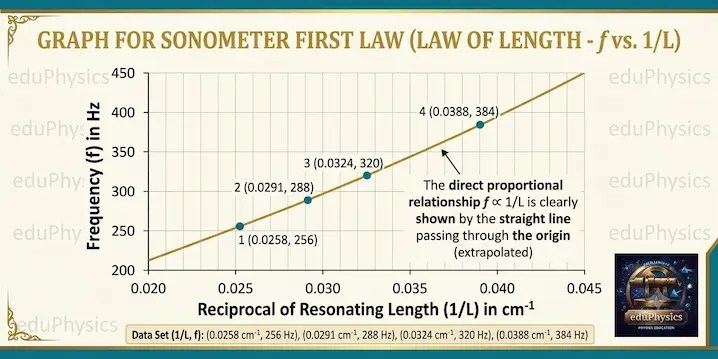
6.1 Observation Table for the First Law (Law of Length)
Tension kept constant: T = 39.2 N (M = 4 kg).
| S. No. | Frequency of tuning fork, f (Hz) | Resonating length, L (cm) | f × L (Hz cm) |
|---|---|---|---|
| 1 | 256 | 38.7 | 9907 |
| 2 | 288 | 34.4 | 9907 |
| 3 | 320 | 30.9 | 9888 |
| 4 | 384 | 25.8 | 9907 |
Inference: The product f × L is approximately constant, so f ∝ 1/L. The first law is verified.

6.2 Observation Table for the Second Law (Law of Tension)
Frequency of tuning fork kept constant: f = 256 Hz.
| S. No. | Suspended mass, M (kg) | Tension, T = Mg (N) | √T (√N) | Resonating length, L (cm) | L² (cm²) | L²/T (cm²/N) |
|---|---|---|---|---|---|---|
| 1 | 1 | 9.8 | 3.13 | 19.3 | 372.5 | 38.0 |
| 2 | 2 | 19.6 | 4.43 | 27.3 | 745.3 | 38.0 |
| 3 | 3 | 29.4 | 5.42 | 33.5 | 1122.3 | 38.2 |
| 4 | 4 | 39.2 | 6.26 | 38.7 | 1497.7 | 38.2 |
Inference: The ratio L²/T is approximately constant, so L² ∝ T (or L ∝ √T). The second law is verified.

6.3 Observation Table for the Third Law (Law of Mass per Unit Length)
Tension kept constant: T = 39.2 N. Frequency of tuning fork: f = 256 Hz.
| S. No. | Mass per unit length, μ (kg/m) | √μ | Resonating length, L (cm) | L × √μ |
|---|---|---|---|---|
| 1 | 0.001 | 0.0316 | 38.7 | 1.224 |
| 2 | 0.002 | 0.0447 | 27.3 | 1.221 |
| 3 | 0.003 | 0.0548 | 22.3 | 1.221 |
| 4 | 0.004 | 0.0632 | 19.3 | 1.221 |
Inference: The product L√μ is approximately constant, so L ∝ 1/√μ. For a fixed frequency this means f ∝ 1/√μ. The third law is verified.

7. Sample Calculations
A. Calculation for the Law of Length
For the 256 Hz fork, L = 38.7 cm: f × L = 256 × 38.7 = 9907 Hz cm.
For the 320 Hz fork, L = 30.9 cm: f × L = 320 × 30.9 = 9888 Hz cm.
The products agree within experimental error, so f × L = constant and f ∝ 1/L.
B. Calculation for the Law of Tension
Suspended masses (including the hanger) are 1 kg and 4 kg, with g = 9.8 m/s².
T₁ = 1 × 9.8 = 9.8 N and T₂ = 4 × 9.8 = 39.2 N, so T₂/T₁ = 4.
For the same fork, L₂/L₁ = 38.7/19.3 ≈ 2.0, so (L₂/L₁)² ≈ 4 = T₂/T₁.
Therefore L² ∝ T. Since f is constant here, the frequency of a string of fixed length is proportional to √T.
C. Calculation for the Law of Mass
Two wires have μ₁ = 0.001 kg/m and μ₂ = 0.004 kg/m, so μ₂/μ₁ = 4.
For the same tension and fork, L₁/L₂ = 38.7/19.3 ≈ 2 = √(μ₂/μ₁).
Therefore L ∝ 1/√μ. For the same length and tension, f₁/f₂ = √(μ₂/μ₁) = 2, so the lighter wire has twice the frequency. Hence f ∝ 1/√μ.
8. Graphical Representation
- Graph 1 (law of length): Plot f on the y-axis against 1/L on the x-axis. A straight line through the origin verifies f ∝ 1/L.
- Graph 2 (law of tension): Plot L² on the y-axis against T on the x-axis. A straight line through the origin verifies L² ∝ T.
- Graph 3 (law of mass): Plot L on the y-axis against 1/√μ on the x-axis. A straight line through the origin verifies L ∝ 1/√μ.
Law of tension – L² versus T

Law of mass – L versus 1/√μ

9. Result
The laws of transverse vibrations of a stretched string are verified experimentally using a sonometer.
- Law of Length: Frequency is inversely proportional to the vibrating length when tension and mass per unit length are constant.
- Law of Tension: Frequency is directly proportional to the square root of tension when vibrating length and mass per unit length are constant.
- Law of Mass: Frequency is inversely proportional to the square root of mass per unit length when vibrating length and tension are constant.
The experimental results agree with the theoretical relation f = (1/2L)√(T/μ).
10. Precautions
- Place the sonometer on a stable, horizontal laboratory table.
- The wire should be uniform and free from kinks.
- Place the bridges perpendicular to the length of the wire.
- Strike the tuning fork gently against a rubber pad, never against a hard surface.
- Place the stem of the vibrating tuning fork firmly on the sounding box.
- The suspended weights should hang freely without touching the table or floor.
- Include the weight hanger while calculating the tension.
- Place the paper rider at the middle of the vibrating portion.
- Measure the vibrating length between the inner edges of the two bridges.
- Identify resonance by the maximum vibration and the falling of the paper rider.
- Do not overload the wire, as it may break.
- Keep the tension constant while verifying the law of length.
- Keep the same tuning fork while verifying the laws of tension and mass.
- Determine the mass per unit length accurately when verifying the law of mass.
11. Sources of Error
- Friction between the wire and the pulley may affect the actual tension.
- The wire may not have perfectly uniform mass per unit length.
- The tuning fork may not be struck consistently.
- The paper rider may not be exactly at the middle of the vibrating portion.
- The bridges may not be sharp or properly aligned.
- Errors may occur while measuring the resonant length.
- The suspended load may oscillate during the experiment.
- Background noise may make resonance harder to identify.
12. Applications of the Laws of Transverse Vibrations
- Musical instruments: The pitch of guitar, violin and sitar strings is controlled by changing their vibrating length and tension.
- Tuning instruments: Musicians adjust string tension to obtain the required notes.
- Instrument design: The thickness and material of a string determine its mass per unit length and hence its frequency.
- Study of sound: The sonometer demonstrates stationary waves and resonance.
- Measurement of frequency: A sonometer can compare the frequency of an unknown source with a known tuning fork.
13. Frequently Asked Viva-Voce Questions and Answers
Q1. What is a sonometer? An instrument used to study the transverse vibrations of a stretched string and verify the laws governing its frequency.
Q2. What are transverse vibrations? Vibrations in which the particles of the medium vibrate perpendicular to the direction of propagation of the wave.
Q3. What is the principle of a sonometer? It works on the principle of resonance and the formation of stationary waves in a stretched string.
Q4. What is resonance? The phenomenon in which a body vibrates with maximum amplitude when the frequency of an external periodic force equals its natural frequency.
Q5. What is the law of length? For a given string under constant tension, the frequency is inversely proportional to the vibrating length.
Q6. What is the law of tension? For a string of constant length and mass per unit length, the frequency is directly proportional to the square root of the tension.
Q7. What is the law of mass? For a string of constant length and tension, the frequency is inversely proportional to the square root of its mass per unit length.
Q8. What is the fundamental mode of vibration? The simplest mode, in which the string has a node at each end and one antinode at the centre.
Q9. What is a stationary wave? A wave formed by the superposition of two waves of the same frequency and amplitude travelling in opposite directions.
Q10. What is a node? A point on a stationary wave where the displacement is always zero.
Q11. What is an antinode? A point on a stationary wave where the amplitude of vibration is maximum.
Q12. Why is a paper rider used? It shows resonance. It is thrown off the wire when the amplitude becomes large.
Q13. Why is a tuning fork used? It produces sound of known and nearly constant frequency, which is needed to study resonance.
Q14. Why is the sonometer box hollow? The hollow box acts as a sounding board and increases the loudness of the sound.
Q15. What is linear mass density? The mass of a string per unit length, expressed in kg/m.
Q16. What happens to the frequency when the length of the string is doubled? It becomes half, if the tension and mass per unit length remain constant.
Q17. What happens to the frequency when the tension is increased four times? It becomes twice, if the length and mass per unit length remain constant.
Q18. What happens to the frequency when the mass per unit length is increased four times? It becomes half, if the length and tension remain constant.
Q19. What is the SI unit of frequency? Hertz (Hz).
Q20. What is the SI unit of tension? Newton (N).
Q21. What is the relation between wavelength and vibrating length in the fundamental mode? The wavelength is twice the vibrating length (λ = 2L).
Q22. Why should the suspended weights hang freely? So that the full weight acts as tension in the wire and no other force, such as contact with the table, changes it.
Q23. What is the effect of increasing the thickness of a wire of the same material? The mass per unit length increases, so the frequency decreases for the same length and tension.
Q24. Why should the tuning fork be struck against a rubber pad? A rubber pad gives a clear vibration without damaging the fork or changing its natural frequency.
Q25. What is the formula for the fundamental frequency of a stretched string? f = (1 / 2L) × √(T / μ).
Q26. Why is the vibrating length measured between the inner edges of the bridges? The wire is effectively fixed at the points where it touches the bridges, so these points are the nodes.
Q27. How does the sonometer help in finding an unknown frequency? By finding the resonant length for the unknown source and using f × L = constant with a known tuning fork at the same tension.
14. Important Points for the NIOS Practical Examination
- Remember the three laws of transverse vibrations.
- Learn the relationship between frequency, length, tension and mass per unit length.
- Understand resonance, nodes and antinodes.
- Practise drawing a labelled diagram of a sonometer.
- Tension = total suspended mass (including the hanger) × g.
- Learn how to calculate mass per unit length.
- Practise plotting the three graphs on graph paper.
- Understand why the paper rider is used to identify resonance.
- Write the result and precautions clearly in the practical record.
Conclusion
The sonometer is an important laboratory instrument for understanding how the frequency of a stretched string depends on its vibrating length, tension and mass per unit length. By changing one quantity at a time, the three laws of transverse vibrations can be verified experimentally. The experiment also gives a practical understanding of resonance, stationary waves, fundamental frequency and the physics behind musical string instruments.
Explore more experiments: NIOS Class 12 Physics practical experiments
Leave a Reply