Class 12/notes/Dual Nature of Radiation and Matter
Introduction
The photoelectric effect is one of the most important phenomena in modern physics. It provides strong evidence for the particle nature of light and played a crucial role in the development of quantum physics.
In 1905, Albert Einstein proposed a revolutionary explanation of the photoelectric effect based on the idea that light consists of discrete packets of energy called photons. His theory successfully explained experimental observations that could not be adequately explained by the classical wave theory of light.
Einstein received the Nobel Prize in Physics in 1921 for his services to theoretical physics, especially for his discovery of the law of the photoelectric effect.
What Is the Photoelectric Effect?
The photoelectric effect is the phenomenon in which electrons are emitted from the surface of a material, usually a metal, when electromagnetic radiation of sufficiently high frequency falls on it.
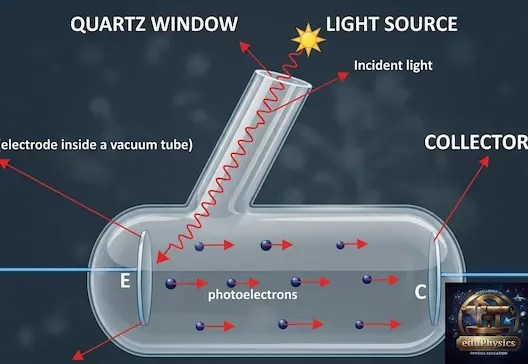
The emitted electrons are called photoelectrons, and the current produced by their motion under suitable electrical conditions is called photoelectric current.
For example, when ultraviolet light of an appropriate frequency falls on a clean metal surface, electrons may escape from the metal. However, if the frequency of the incident light is below a certain minimum value, electrons will not be emitted, even when the intensity of light is increased substantially.
This observation is one of the key features explained by Einstein’s theory.

Why Was Einstein’s Theory Needed?
Why Was Einstein’s Theory Needed?
Before Einstein proposed his theory, light was widely described using the classical electromagnetic wave theory. According to this theory, light carries energy continuously, and the energy delivered to a surface depends on the intensity of the radiation.
However, experiments on the photoelectric effect revealed several observations that classical wave theory could not satisfactorily explain.
The major experimental observations were:
- Existence of threshold frequency: Photoelectric emission occurs only when the frequency of incident light is equal to or greater than a minimum value called the threshold frequency.
- Instantaneous emission: Photoelectrons are emitted almost immediately when suitable light falls on the metal surface, even at very low intensities.
- Dependence of maximum kinetic energy on frequency: The maximum kinetic energy of photoelectrons increases with the frequency of incident light, provided the frequency is above the threshold value.
- Dependence of photoelectric current on intensity: For a fixed frequency above the threshold and under suitable experimental conditions, increasing the intensity of incident light generally increases the number of emitted photoelectrons per second and hence the photoelectric current.
These observations motivated Einstein to develop a new explanation based on the quantum nature of light.
Einstein’s Quantum Theory of Light
Einstein extended Max Planck’s idea of energy quantisation and proposed that light consists of individual packets of energy called photons.
According to Einstein’s theory:
- Light energy is emitted and absorbed in discrete packets called photons.
- The energy of each photon depends on the frequency of the radiation.
- Each photon carries energy proportional to its frequency.
- During photoelectric emission, one photon transfers its energy to one electron in the elementary interaction.
- A portion of the photon’s energy is used to overcome the attractive forces binding the electron to the metal.
- The remaining energy appears as the kinetic energy of the emitted electron, if sufficient energy is available.
The energy of a photon is given by:
Photon energy = hν
Here,
- h = Planck’s constant, approximately 6.626 × 10⁻³⁴ joule-second
- ν = Frequency of the incident radiation
Since the frequency of light is related to its wavelength, the energy of a photon can also be expressed as:
Photon energy = hc/λ
where c is the speed of light in vacuum and λ is the wavelength of the radiation.
Thus, photons of higher frequency have greater energy, whereas photons of lower frequency have less energy.
Einstein’s Explanation of the Photoelectric Effect
Einstein explained photoelectric emission by considering the interaction between individual photons and electrons in a metal.
Step 1: Absorption of a Photon
When light falls on a metal surface, an electron may absorb the energy of a single photon.
The energy transferred to the electron is equal to the energy of the incident photon, provided the photon is absorbed.
Step 2: Overcoming the Work Function
Electrons inside a metal are bound to the material. A certain minimum energy is required to remove an electron from the surface.
This minimum energy is called the work function of the metal and is represented by the symbol φ.
The work function depends on the nature and surface condition of the material.
Step 3: Emission of the Electron
If the photon energy is less than the work function, the photon cannot provide sufficient energy for photoelectric emission through this process.
If the photon energy is equal to the work function, the electron can just escape from the metal surface with negligible kinetic energy.
If the photon energy exceeds the work function, the electron can escape with some remaining energy in the form of kinetic energy.
Step 4: Kinetic Energy of the Photoelectron
The maximum kinetic energy of an emitted photoelectron is obtained when the energy required to escape from the metal is the minimum possible for the emitting electron.
Einstein expressed this energy balance through his famous photoelectric equation.
Einstein’s Photoelectric Equation
The total energy of an incident photon is used partly to overcome the work function of the metal and partly to provide kinetic energy to the emitted electron.
Therefore,
Energy of incident photon = Work function + Maximum kinetic energy of photoelectron
The equation is:
hν = φ + Kₘₐₓ
Hence,
Kₘₐₓ = hν − φ
This is known as Einstein’s photoelectric equation.
Since the work function is related to the threshold frequency by φ = hν₀, the equation can also be written as:
Kₘₐₓ = h(ν − ν₀)
Here,
- Kₘₐₓ = Maximum kinetic energy of the photoelectrons
- h = Planck’s constant
- ν = Frequency of incident radiation
- φ = Work function of the metal
- ν₀ = Threshold frequency of the metal
The equation demonstrates that the maximum kinetic energy of photoelectrons increases linearly with the frequency of incident light.
It also shows that photoelectric emission is possible only when the photon energy is sufficient to overcome the work function.
Threshold Frequency and Threshold Wavelength
Threshold Frequency
The threshold frequency is the minimum frequency of incident radiation required to produce photoelectric emission from a particular material.
It is represented by ν₀.
At the threshold frequency, the photon energy is just sufficient to overcome the work function.
Therefore,
φ = hν₀
If the frequency of incident light is less than the threshold frequency, photoelectric emission does not occur through the ordinary single-photon photoelectric effect, regardless of how much the intensity is increased.
Threshold Wavelength
The threshold wavelength is the maximum wavelength of incident radiation that can produce photoelectric emission from a material.
It is represented by λ₀.
Using the relation between frequency and wavelength, the threshold wavelength is:
λ₀ = c/ν₀
Since the work function is equal to hν₀,
λ₀ = hc/φ
Thus, a material with a larger work function has a higher threshold frequency and a shorter threshold wavelength.
Effect of Frequency and Intensity on Photoelectric Emission
Einstein’s theory clearly distinguishes the effects of frequency and intensity.
Effect of Frequency
When the frequency of incident radiation increases above the threshold frequency, the energy of each photon increases.
As a result, the maximum kinetic energy of the photoelectrons increases.
For a given metal, the maximum kinetic energy varies linearly with the frequency of the incident radiation.
If the frequency is below the threshold value, ordinary photoelectric emission does not occur, even at high intensity.

Effect of Intensity
For monochromatic light of a fixed frequency above the threshold frequency, increasing the intensity increases the number of incident photons per second.
Under suitable conditions, this leads to the emission of more photoelectrons per second and an increase in photoelectric current.
However, increasing intensity does not increase the energy of each photon because photon energy depends on frequency, not intensity.
Consequently, for a fixed frequency, increasing light intensity does not increase the maximum kinetic energy of the photoelectrons.
Important distinction: Frequency determines the energy of each photon, whereas intensity is related to the energy delivered by the radiation per unit area per unit time. For fixed-frequency light, greater intensity generally means a greater photon flux.

Stopping Potential and Einstein’s Equation
The maximum kinetic energy of photoelectrons can be determined experimentally using the concept of stopping potential.
The stopping potential is the minimum reverse potential applied between the electrodes that prevents even the most energetic photoelectrons from reaching the collecting electrode.
It is represented by V₀.
At the stopping potential, the maximum kinetic energy of the photoelectrons is equal to the magnitude of the electronic charge multiplied by the stopping potential.
Therefore,
Kₘₐₓ = eV₀
Combining this relation with Einstein’s photoelectric equation gives:
eV₀ = hν − φ
Therefore,
V₀ = (h/e)ν − φ/e
This equation shows that the stopping potential increases linearly with the frequency of incident radiation for a given material.
The stopping potential depends on the frequency of the incident light and the work function of the material, but not on the intensity of the light under ideal photoelectric conditions.
Graphical Representation of Einstein’s Photoelectric Equation
1. Graph of Maximum Kinetic Energy Versus Frequency
According to Einstein’s equation,
Kₘₐₓ = hν − φ
The graph of maximum kinetic energy against frequency is a straight line.
Its important features are:
- The slope of the graph is Planck’s constant, h, when kinetic energy is measured in joules and frequency in hertz.
- The frequency-axis intercept is the threshold frequency, ν₀.
- The maximum kinetic energy increases linearly with frequency above the threshold.
- The graph does not depend on light intensity when the frequency is fixed.
2. Graph of Stopping Potential Versus Frequency
From the equation,
V₀ = (h/e)ν − φ/e
the stopping potential versus frequency graph is also a straight line.
Its slope is h/e, and its frequency-axis intercept is the threshold frequency.
This graph provides an experimental method for determining Planck’s constant.
3. Graph of Photoelectric Current Versus Intensity
For a fixed frequency above the threshold and suitable experimental conditions, the photoelectric current increases with the intensity of incident radiation.
At a fixed collecting potential, the current is approximately proportional to the intensity over the appropriate operating range.
At sufficiently positive collecting potentials, the current approaches a saturation value because the emitted photoelectrons are collected efficiently.
This graph illustrates the relationship between intensity and the number of photoelectrons emitted per second.
Numerical Example Based on Einstein’s Photoelectric Equation
Question: Light of frequency 8 × 10¹⁴ Hz falls on a metal having a work function of 2 eV. Calculate the maximum kinetic energy of the emitted photoelectrons.
Given:
Frequency of incident light = 8 × 10¹⁴ Hz
Work function = 2 eV
Planck’s constant = 4.136 × 10⁻¹⁵ eV s
Step 1: Calculate the energy of the incident photon.
Photon energy = hν
= 4.136 × 10⁻¹⁵ × 8 × 10¹⁴
= 3.309 eV approximately
Step 2: Apply Einstein’s photoelectric equation.
Maximum kinetic energy = Photon energy − Work function
= 3.309 − 2
= 1.309 eV
Answer: The maximum kinetic energy of the emitted photoelectrons is approximately 1.31 eV.
Applications of the Photoelectric Effect
Applications of the Photoelectric Effect
The principles of the photoelectric effect are used in several technologies.
1. Photocells
Photocells detect light and convert changes in illumination into electrical signals. Depending on the design, they may use external or internal photoelectric effects.
2. Automatic Streetlights
Light sensors can detect changes in ambient illumination and control streetlights automatically.
3. Burglar Alarm Systems
Photoelectric sensors are used in security systems to detect interruptions in a light beam or changes in received light.
4. Light Meters
Photodetectors measure light intensity in photography, laboratories and industrial equipment.
5. Scientific Instruments
Photoelectric detectors are used in spectroscopy and other scientific instruments to detect light and measure radiation.
6. Solar Cells
Solar cells operate primarily through the internal photoelectric effect, more specifically the photovoltaic effect, in semiconductor materials. Light generates charge carriers that contribute to an electrical current.
Although solar cells and the external photoelectric effect are related through light-matter interactions, their operating mechanisms are not identical.
Limitations and Important Clarifications
Einstein’s photoelectric equation describes the basic energy balance for ordinary single-photon photoelectric emission. Real materials may exhibit additional effects because of surface conditions, electron energy distributions and experimental geometry.
The following distinctions are important:
- The work function varies from one material to another and can be affected by surface contamination.
- The maximum kinetic energy is not the same as the average kinetic energy of all emitted photoelectrons.
- Increasing intensity at fixed frequency increases photon flux, but it does not increase the energy of an individual photon.
- The stopping potential is related to the maximum kinetic energy, not the total number of photoelectrons emitted.
- At extremely high intensities, multiphoton processes may occur; these are beyond the ordinary single-photon explanation.
Important Questions for CBSE, NEET and JEE
Very Short Answer Questions
1. Who proposed the quantum explanation of the photoelectric effect?
Albert Einstein proposed the quantum explanation in 1905.
2. What is a photon?
A photon is a quantum of electromagnetic radiation whose energy is proportional to its frequency.
3. What is the work function?
The work function is the minimum energy required to remove an electron from the surface of a material.
4. What is the threshold frequency?
It is the minimum frequency of incident radiation required to produce photoelectric emission from a particular material.
5. Does increasing intensity increase the maximum kinetic energy of photoelectrons?
No. At a fixed frequency above the threshold, increasing intensity does not increase the maximum kinetic energy under ordinary photoelectric conditions.
Short Answer Questions
1. State Einstein’s photoelectric equation.
Einstein’s photoelectric equation is:
hν = φ + Kₘₐₓ
It states that the energy of an incident photon is used to overcome the work function and provide the maximum kinetic energy of the emitted photoelectron.
2. Why does photoelectric emission not occur below the threshold frequency?
Below the threshold frequency, the energy of an individual photon is less than the work function. Therefore, a single photon cannot provide sufficient energy for ordinary photoelectric emission, regardless of the intensity of the incident light.
3. Why does the stopping potential increase with frequency?
Increasing the frequency increases photon energy. The excess energy after overcoming the work function appears as maximum kinetic energy, which requires a larger stopping potential to prevent the most energetic photoelectrons from reaching the collector.
4. Why does photoelectric current increase with intensity?
At a fixed frequency above the threshold, greater intensity generally corresponds to more photons arriving per second. This can produce more photoelectrons per second, increasing the photoelectric current.
Long Answer Question
Explain Einstein’s theory of the photoelectric effect and derive the photoelectric equation.
Einstein proposed that light consists of photons, each having energy hν. When a photon is absorbed by an electron in a metal, its energy is transferred to the electron. A minimum energy φ is required for the electron to escape from the metal surface. Any remaining energy appears as kinetic energy.
Applying conservation of energy:
Energy of incident photon = Work function + Maximum kinetic energy
Therefore,
hν = φ + Kₘₐₓ
Hence,
Kₘₐₓ = hν − φ
Since φ = hν₀,
Kₘₐₓ = h(ν − ν₀)
This equation explains the threshold frequency, the linear dependence of maximum kinetic energy on frequency, and the independence of maximum kinetic energy from intensity at a fixed frequency.
Conclusion
Einstein’s theory of the photoelectric effect was a landmark achievement in modern physics. By proposing that light transfers energy in discrete packets called photons, Einstein explained observations that classical wave theory could not adequately account for.
His photoelectric equation connects photon energy, work function and maximum kinetic energy, providing a quantitative explanation of photoelectric emission.
The theory established a fundamental link between light and matter and contributed significantly to the development of quantum physics. It remains an essential topic for CBSE Class 12 Physics, NEET and JEE examinations.
Quick Revision: Key Formulae
- Photon energy: E = hν = hc/λ
- Einstein’s photoelectric equation: hν = φ + Kₘₐₓ
- Maximum kinetic energy: Kₘₐₓ = hν − φ
- Work function: φ = hν₀
- Threshold wavelength: λ₀ = c/ν₀
- Stopping potential relation: Kₘₐₓ = eV₀
- Stopping potential equation: eV₀ = hν − φ
Exam tip: Remember that the frequency of light determines the energy of each photon, whereas intensity at a fixed frequency primarily determines the photon flux and, under suitable conditions, the photoelectric current.
Leave a Reply