Class 12/Modern Physics/NEET & JEE preparation
Introduction
The atomic nucleus is the tiny, dense central region of an atom that contains almost all its mass. Understanding the composition of the nucleus, atomic number, mass number, isotopes, isobars, isotones, atomic mass unit, nuclear radius, and nuclear density is essential for mastering nuclear physics.
These concepts are important for CBSE Class 12 Physics, NEET UG, JEE Main, and JEE Advanced examinations. They also form the foundation for understanding nuclear binding energy, radioactivity, nuclear reactions, and the stability of atomic nuclei.
In this guide, we will explore the fundamental properties of the atomic nucleus, understand the differences between isotopes, isobars, and isotones, derive the important nuclear formulas, solve numerical problems, and practise multiple-choice questions.
1. Composition of the Atomic Nucleus: Protons, Neutrons and Nucleons
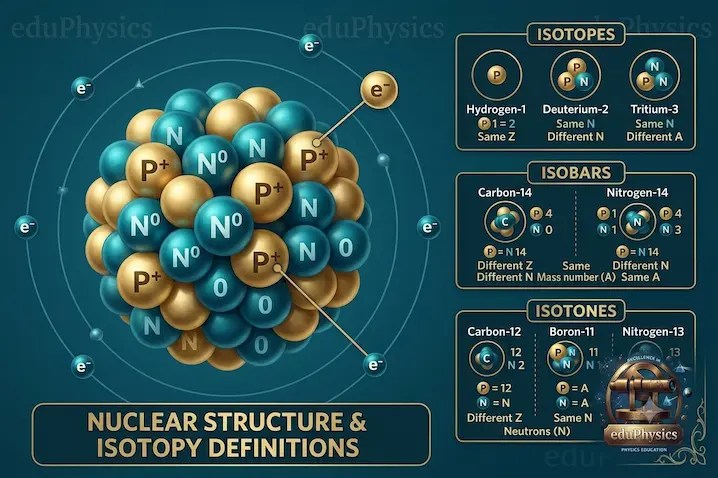
The nucleus lies at the centre of an atom. It is positively charged because it contains positively charged protons. Neutrons, which have no electric charge, are also present in most atomic nuclei.
The particles present in the nucleus are collectively called nucleons.
Protons
A proton is a positively charged subatomic particle found inside the nucleus.
- Charge: +1e, or approximately +1.602 × 10⁻¹⁹ coulomb
- Mass: approximately 1.673 × 10⁻²⁷ kg
- Symbol: p
- Relative charge: +1
The number of protons determines the identity of an element. For example, every carbon nucleus contains six protons, while every oxygen nucleus contains eight protons.
Neutrons
A neutron is an electrically neutral subatomic particle found in the nucleus.
- Charge: 0
- Mass: approximately 1.675 × 10⁻²⁷ kg
- Symbol: n
- Relative charge: 0
Neutrons contribute to nuclear mass and play an important role in nuclear stability. Different numbers of neutrons in nuclei of the same element give rise to isotopes.
Nucleons
Protons and neutrons are collectively known as nucleons.
If a nucleus contains Z protons and N neutrons, its total number of nucleons is:
A = Z + N
Therefore:
N = A − Z
Here:
- A = mass number
- Z = atomic number
- N = number of neutrons
For example, a carbon-12 nucleus contains 6 protons and 6 neutrons.
A = 6 + 6 = 12
Hence, the total number of nucleons is 12.
What holds the nucleus together?
Protons repel one another because they carry positive charges. However, atomic nuclei remain bound because of the strong nuclear interaction between nucleons. At nuclear distances, this interaction is attractive and can overcome the electrostatic repulsion between protons.
The strong nuclear interaction is short-ranged, acting significantly over distances of the order of a few femtometres.
One femtometre (fm) = 10⁻¹⁵ m.
Key exam point: The atomic nucleus occupies a very small fraction of the atom’s volume, yet it contains nearly all the atom’s mass.
2. Atomic Number, Mass Number and Nuclear Notation
Atomic number and mass number are two fundamental quantities used to describe an atomic nucleus.
Atomic number (Z)
The atomic number is the number of protons present in the nucleus.
Atomic number = Number of protons
For a neutral atom, the number of electrons is also equal to the atomic number.
Examples:
- Hydrogen: Z = 1
- Carbon: Z = 6
- Oxygen: Z = 8
- Sodium: Z = 11
- Uranium: Z = 92
The atomic number uniquely identifies the chemical element.
Mass number (A)
The mass number is the total number of protons and neutrons present in the nucleus.
Mass number = Number of protons + Number of neutrons
Therefore:
A = Z + N
The mass number is always a whole number because it represents a count of nucleons.
Nuclear notation
A nucleus is conventionally represented as:
ᴬZX
Here:
- X represents the chemical symbol of the element.
- A represents the mass number, written at the upper left.
- Z represents the atomic number, written at the lower left.
For example, carbon-12 is written as ¹²₆C.
For this nucleus:
- Atomic number = 6
- Mass number = 12
- Number of protons = 6
- Number of neutrons = 12 − 6 = 6
Similarly, sodium-23 is represented by ²³₁₁Na.
It contains 11 protons and 12 neutrons.
Solved example 1: Find the number of protons, neutrons and electrons
An atom is represented by ⁴⁰₂₀Ca. Find its number of protons, neutrons, and electrons.
Solution
Atomic number, Z = 20.
Therefore, number of protons = 20.
Mass number, A = 40.
Number of neutrons = A − Z = 40 − 20 = 20.
Since the atom is neutral, number of electrons = 20.
Answer: 20 protons, 20 neutrons, and 20 electrons.
Solved example 2: Identify an unknown nucleus
A nucleus contains 17 protons and 18 neutrons. Identify its atomic number, mass number, and element.
Solution
Atomic number, Z = 17.
Mass number, A = 17 + 18 = 35.
The element with atomic number 17 is chlorine.
Answer: The nucleus is chlorine-35, represented as ³⁵₁₇Cl.
Exam tip: Do not confuse mass number with atomic mass. Mass number is an integer count of nucleons, whereas the measured isotopic mass is expressed in atomic mass units and is not necessarily an integer.
3. Isotopes, Isobars and Isotones: Differences and Examples
Isotopes, isobars, and isotones are three important categories used to compare atomic nuclei. Questions on their definitions, examples, and identification frequently appear in school and competitive examinations.
Isotopes
Isotopes are atoms of the same element that have the same atomic number but different mass numbers.
They contain the same number of protons but different numbers of neutrons.
Examples:
- Hydrogen-1: ¹₁H
- Hydrogen-2: ²₁H
- Hydrogen-3: ³₁H
All three have one proton, but they contain zero, one, and two neutrons, respectively.
Another example is carbon-12 and carbon-14:
- Carbon-12: ¹²₆C, containing 6 neutrons
- Carbon-14: ¹⁴₆C, containing 8 neutrons
Both are isotopes of carbon because their atomic number is 6.
Important property: Isotopes have the same number of protons and, in neutral atoms, the same number of electrons. Consequently, they generally have very similar chemical properties, although their physical properties and nuclear stability can differ.
Isobars
Isobars are nuclei of different elements that have the same mass number but different atomic numbers.
Examples:
- Argon-40: ⁴⁰₁₈Ar
- Calcium-40: ⁴⁰₂₀Ca
Both have mass number 40, but argon has 18 protons while calcium has 20 protons.
Another example is carbon-14 and nitrogen-14:
- Carbon-14: ¹⁴₆C
- Nitrogen-14: ¹⁴₇N
Both have mass number 14 but different atomic numbers.
Isotones
Isotones are nuclei of different elements that have the same number of neutrons but different atomic numbers.
Examples:
- Carbon-14: ¹⁴₆C
- Nitrogen-15: ¹⁵₇N
For carbon-14:
Number of neutrons = 14 − 6 = 8.
For nitrogen-15:
Number of neutrons = 15 − 7 = 8.
Both nuclei contain eight neutrons, so they are isotones.
Another example is oxygen-16 and fluorine-17:
- Oxygen-16: ¹⁶₈O, containing 8 neutrons
- Fluorine-17: ¹⁷₉F, containing 8 neutrons
Difference between isotopes, isobars and isotones
| Property | Isotopes | Isobars | Isotones |
| Atomic number (Z) | Same | Different | Different |
| Mass number (A) | Different | Same | Different |
| Number of neutrons (N) | Different | Usually different | Same |
| Element identity | Same element | Different elements | Different elements |
| Example | ¹²₆C and ¹⁴₆C | ⁴⁰₁₈Ar and ⁴⁰₂₀Ca | ¹⁴₆C and ¹⁵₇N |
A quick method to identify them
Remember these three rules:
- Isotopes: Same Z, different A.
- Isobars: Same A, different Z.
- Isotones: Same N, different Z.
For isotones, always calculate the number of neutrons using N = A − Z instead of comparing mass numbers alone.
NEET shortcut: If two nuclei have the same mass number, they may be isobars. If they have the same atomic number, they may be isotopes. If they have the same neutron number, they may be isotones. Check the remaining quantities before deciding.
4. Atomic Mass Unit (amu): Definition and Conversion

The atomic mass unit is a convenient unit for expressing the masses of atoms, nuclei, and subatomic particles. Their masses in kilograms are extremely small, so using kilograms for every calculation is often inconvenient.
The atomic mass unit is also called the unified atomic mass unit and is represented by u. The symbol amu is widely used in textbooks.
Definition of atomic mass unit
One atomic mass unit is defined as one-twelfth of the mass of a neutral carbon-12 atom in its ground state.
1 u = 1/12 × mass of one carbon-12 atom
Its value is approximately:
1 u = 1.66054 × 10⁻²⁷ kg
In energy units, using Einstein’s mass-energy relation:
1 u ≈ 931.5 MeV/c²
Equivalently, the rest energy corresponding to one atomic mass unit is approximately 931.5 MeV.
Approximate masses of subatomic particles
| Particle | Approximate mass in kg | Approximate mass in u |
| Proton | 1.673 × 10⁻²⁷ | 1.0073 |
| Neutron | 1.675 × 10⁻²⁷ | 1.0087 |
| Electron | 9.109 × 10⁻³¹ | 0.000549 |
The proton and neutron masses are close to 1 u, while the electron mass is much smaller.
Conversion between u and kg
To convert atomic mass units into kilograms, multiply the mass in u by 1.66054 × 10⁻²⁷.
Mass in kg = Mass in u × 1.66054 × 10⁻²⁷
To convert kilograms into atomic mass units, divide the mass in kilograms by 1.66054 × 10⁻²⁷.
Mass in u = Mass in kg ÷ 1.66054 × 10⁻²⁷
Solved example 3: Convert atomic mass into kilograms
The mass of a particle is 12 u. Find its mass in kilograms.
Solution
Mass = 12 × 1.66054 × 10⁻²⁷ kg
Mass ≈ 1.993 × 10⁻²⁶ kg.
Answer: 1.993 × 10⁻²⁶ kg.
Solved example 4: Convert mass into energy units
Find the rest energy equivalent of a mass of 2 u in MeV.
Solution
Rest energy equivalent of 1 u ≈ 931.5 MeV.
Therefore, for 2 u:
E = 2 × 931.5 = 1863 MeV.
Answer: 1863 MeV.
Important distinction: The atomic mass unit is a unit of mass. MeV is a unit of energy, whereas MeV/c² is a unit of mass.
5. Nuclear Size and Nuclear Radius Formula

The nucleus is extremely small compared with the atom. Although the radius of an atom is typically of the order of 10⁻¹⁰ m, the nuclear radius is of the order of 10⁻¹⁵ to 10⁻¹⁴ m, depending on the nucleus.
Experimental studies show that the nuclear radius depends approximately on the cube root of the mass number.
Nuclear radius formula
The empirical nuclear radius formula is:
R = R₀A^(1/3)
Here:
- R = radius of the nucleus
- R₀ = empirical nuclear radius constant, approximately 1.2 fm
- A = mass number
Using R₀ ≈ 1.2 × 10⁻¹⁵ m:
R ≈ 1.2 × 10⁻¹⁵ A^(1/3) m
The value of R₀ is approximate; values around 1.1–1.2 fm are used depending on the model and experimental convention.
What does the formula tell us?
The nuclear radius is proportional to the cube root of the mass number.
R ∝ A^(1/3)
If the mass number increases by a factor of 8, the radius increases by a factor of 2 because the cube root of 8 is 2.
If the mass number increases by a factor of 27, the radius increases by a factor of 3.
This means that heavy nuclei are larger than light nuclei, but the radius does not increase in direct proportion to the mass number.
Solved example 5: Calculate the radius of a carbon-12 nucleus
Find the approximate radius of a carbon-12 nucleus using R₀ = 1.2 fm.
Solution
For carbon-12, A = 12.
R = 1.2 × 12^(1/3) fm.
Since 12^(1/3) ≈ 2.289:
R ≈ 1.2 × 2.289 fm.
R ≈ 2.75 fm.
Answer: The approximate nuclear radius is 2.75 × 10⁻¹⁵ m.
Solved example 6: Compare two nuclear radii
Find the ratio of the radii of nuclei with mass numbers 64 and 8.
Solution
R₁/R₂ = (A₁/A₂)^(1/3)
R₁/R₂ = (64/8)^(1/3)
R₁/R₂ = 8^(1/3) = 2.
Answer: The radius ratio is 2:1.
Nuclear volume and mass number
Approximating the nucleus as a sphere:
Volume = (4/3)πR³.
Substituting R = R₀A^(1/3):
Volume = (4/3)πR₀³A.
Therefore:
Nuclear volume ∝ A
Since the number of nucleons is also proportional to A, the nuclear volume per nucleon is approximately constant.
This observation is important for understanding why nuclear density is nearly independent of mass number.
6. Nuclear Density: Formula, Properties and Solved Numericals
Nuclear density is the mass of a nucleus divided by its volume. Atomic nuclei have remarkably high densities compared with ordinary materials.
For an approximate calculation, we treat the nucleus as a sphere and take its mass to be approximately A times the nucleon mass.
Nuclear density formula
Density = Mass ÷ Volume
The approximate nuclear mass is:
M ≈ A × mₙ
Here, mₙ represents a typical nucleon mass, approximately 1.67 × 10⁻²⁷ kg.
The volume of a spherical nucleus is:
V = (4/3)πR³
Using R = R₀A^(1/3):
V = (4/3)πR₀³A
Therefore:
ρ = (A × mₙ) ÷ [(4/3)πR₀³A]
The factor A cancels, giving:
ρ ≈ 3mₙ/(4πR₀³)
This shows that nuclear density is approximately independent of mass number.
Numerical value of nuclear density
Taking:
- mₙ ≈ 1.67 × 10⁻²⁷ kg
- R₀ = 1.2 × 10⁻¹⁵ m
We obtain:
ρ ≈ [3 × 1.67 × 10⁻²⁷] ÷ [4π × (1.2 × 10⁻¹⁵)³]
The result is approximately:
ρ ≈ 2.3 × 10¹⁷ kg/m³
This is an order-of-magnitude estimate. Depending on the adopted nuclear radius constant and density model, values of nuclear density are commonly quoted around 10¹⁷–10¹⁸ kg/m³.
Properties of nuclear density
- Nuclear density is extremely high compared with ordinary matter.
- Nuclear density is approximately constant for many nuclei.
- Nuclear mass is approximately proportional to the mass number A.
- Nuclear volume is also approximately proportional to A.
- Because mass and volume scale similarly, their ratio remains approximately constant.
Solved example 7: Find the nuclear density
A nucleus has mass number A = 27. Assume its mass is 27 times the nucleon mass and its radius is given by R = 1.2A^(1/3) fm. Calculate its approximate density.
Solution
Mass of nucleus:
M ≈ 27 × 1.67 × 10⁻²⁷ kg
M ≈ 4.509 × 10⁻²⁶ kg.
Radius:
R = 1.2 × 27^(1/3) fm.
Since 27^(1/3) = 3:
R = 3.6 fm = 3.6 × 10⁻¹⁵ m.
Volume:
V = (4/3)πR³
V ≈ (4/3)π × (3.6 × 10⁻¹⁵)³
V ≈ 1.95 × 10⁻⁴³ m³.
Density:
ρ = M/V
ρ ≈ (4.509 × 10⁻²⁶) ÷ (1.95 × 10⁻⁴³)
ρ ≈ 2.31 × 10¹⁷ kg/m³.
Answer: Approximately 2.3 × 10¹⁷ kg/m³.
The result agrees with the approximate nuclear density obtained from the general formula.
Solved example 8: How does nuclear density change with mass number?
If the mass number of a nucleus increases from 16 to 128, how does its approximate nuclear density change under the standard nuclear radius model?
Solution
Mass is proportional to A.
Volume is proportional to R³.
Since R ∝ A^(1/3), volume is proportional to A.
Therefore:
Density ∝ A/A = constant.
Answer: The nuclear density remains approximately unchanged.
Exam tip: In problems using R = R₀A^(1/3), remember that the mass number cancels when calculating nuclear density. This is a common conceptual and numerical question in NEET and JEE examinations.
7. NEET and JEE Multiple-Choice Questions with Answers
Test your understanding of nuclear composition, nuclear notation, isotopes, isobars, isotones, atomic mass units, nuclear radius, and nuclear density.
Question 1: Composition of the nucleus
The particles collectively known as nucleons are:
A. Protons and electrons
B. Neutrons and electrons
C. Protons and neutrons
D. Electrons and photons
Correct answer: C. Protons and neutrons
Explanation: Protons and neutrons are the particles that make up atomic nuclei and are collectively called nucleons.
Question 2: Number of neutrons
How many neutrons are present in ²³₁₁Na?
A. 11
B. 12
C. 23
D. 34
Correct answer: B. 12
Explanation: Number of neutrons = A − Z = 23 − 11 = 12.
Question 3: Identifying isotopes
Which pair represents isotopes?
A. ⁴⁰₁₈Ar and ⁴⁰₂₀Ca
B. ¹⁴₆C and ¹⁵₇N
C. ¹²₆C and ¹⁴₆C
D. ¹⁶₈O and ¹⁷₉F
Correct answer: C. ¹²₆C and ¹⁴₆C
Explanation: Isotopes have the same atomic number but different mass numbers.
Question 4: Identifying isobars
Which pair consists of isobars?
A. ¹²₆C and ¹⁴₆C
B. ⁴⁰₁₈Ar and ⁴⁰₂₀Ca
C. ¹⁴₆C and ¹⁵₇N
D. ¹⁶₈O and ¹⁶₈O
Correct answer: B. ⁴⁰₁₈Ar and ⁴⁰₂₀Ca
Explanation: Both nuclei have mass number 40 but different atomic numbers.
Question 5: Identifying isotones
Which pair represents isotones?
A. ¹²₆C and ¹⁴₆C
B. ⁴⁰₁₈Ar and ⁴⁰₂₀Ca
C. ¹⁴₆C and ¹⁵₇N
D. ¹⁶₈O and ¹⁸₈O
Correct answer: C. ¹⁴₆C and ¹⁵₇N
Explanation: Carbon-14 has 14 − 6 = 8 neutrons. Nitrogen-15 has 15 − 7 = 8 neutrons.
Question 6: Atomic mass unit
One atomic mass unit is defined as:
A. The mass of one proton
B. The mass of one neutron
C. One-twelfth of the mass of a carbon-12 atom
D. The mass of one electron
Correct answer: C. One-twelfth of the mass of a carbon-12 atom
Explanation: This is the defining reference for the unified atomic mass unit.
Question 7: Conversion into kilograms
The approximate mass corresponding to 1 u is:
A. 1.66 × 10⁻²⁷ kg
B. 1.66 × 10⁻¹⁹ kg
C. 9.11 × 10⁻³¹ kg
D. 6.02 × 10²³ kg
Correct answer: A. 1.66 × 10⁻²⁷ kg
Explanation: The unified atomic mass unit is approximately 1.66054 × 10⁻²⁷ kg.
Question 8: Nuclear radius
The nuclear radius R varies with mass number A approximately as:
A. R ∝ A
B. R ∝ A²
C. R ∝ A^(1/3)
D. R ∝ A⁻¹
Correct answer: C. R ∝ A^(1/3)
Explanation: The empirical nuclear radius relation is R = R₀A^(1/3).
Question 9: Ratio of nuclear radii
The ratio of the radii of nuclei with mass numbers 125 and 8 is:
A. 5:2
B. 25:4
C. 125:8
D. 2:5
Correct answer: A. 5:2
Explanation: The ratio is (125/8)^(1/3) = 5/2.
Question 10: Nuclear density
According to the standard nuclear radius model, nuclear density is approximately:
A. Proportional to A
B. Proportional to A²
C. Inversely proportional to A
D. Independent of A
Correct answer: D. Independent of A
Explanation: Nuclear mass is proportional to A, and nuclear volume is also proportional to A. Their ratio is therefore approximately constant.
Question 11: Rest energy equivalent
The rest energy equivalent of 1 u is approximately:
A. 93.15 keV
B. 931.5 keV
C. 931.5 MeV
D. 9.315 GeV
Correct answer: C. 931.5 MeV
Explanation: The relation is 1 u × c² ≈ 931.5 MeV.
Question 12: Neutron count
A nucleus has atomic number 15 and mass number 31. Its number of neutrons is:
A. 15
B. 16
C. 31
D. 46
Correct answer: B. 16
Explanation: N = A − Z = 31 − 15 = 16.
Question 13: Nuclear radius calculation
Using R = 1.2A^(1/3) fm, the approximate radius of a nucleus with A = 64 is:
A. 1.2 fm
B. 2.4 fm
C. 4.8 fm
D. 7.2 fm
Correct answer: C. 4.8 fm
Explanation: The cube root of 64 is 4. Hence, R = 1.2 × 4 = 4.8 fm.
Question 14: Neutron number and isotones
Two nuclei are isotones if they have the same:
A. Atomic number
B. Mass number
C. Number of protons
D. Number of neutrons
Correct answer: D. Number of neutrons
Explanation: Isotones are nuclei with equal neutron numbers but different atomic numbers.
Question 15: Nuclear volume
If the mass number of a nucleus increases by a factor of 8, its nuclear radius increases approximately by a factor of:
A. 2
B. 4
C. 8
D. 16
Correct answer: A. 2
Explanation: Since R ∝ A^(1/3), the radius increases by 8^(1/3) = 2.
Quick revision: Important nuclear physics formulas
| Quantity | Formula or value |
| Mass number | A = Z + N |
| Number of neutrons | N = A − Z |
| Atomic mass unit | 1 u ≈ 1.66054 × 10⁻²⁷ kg |
| Mass-energy equivalent | 1 u × c² ≈ 931.5 MeV |
| Nuclear radius | R = R₀A^(1/3) |
| Radius constant | R₀ ≈ 1.2 fm |
| Nuclear volume | V = (4/3)πR³ |
| Nuclear density | ρ = M/V |
| Approximate nuclear density | Of the order of 10¹⁷ kg/m³ |
Conclusion
The atomic nucleus consists of protons and neutrons, collectively known as nucleons. Atomic number determines the identity of an element, while mass number gives the total number of nucleons. Isotopes have the same atomic number, isobars have the same mass number, and isotones have the same number of neutrons.
The atomic mass unit provides a convenient scale for atomic and nuclear masses. The nuclear radius follows the approximate relation R = R₀A^(1/3), and nuclear density remains approximately constant across many nuclei because both nuclear mass and volume scale with mass number.
Mastering these definitions, relationships, and numerical methods will help you build a strong foundation in nuclear physics for CBSE Class 12, NEET UG, and JEE examinations.
Explore more physics notes, formula sheets, practical resources, and exam practice materials at eduPhysics.
Leave a Reply